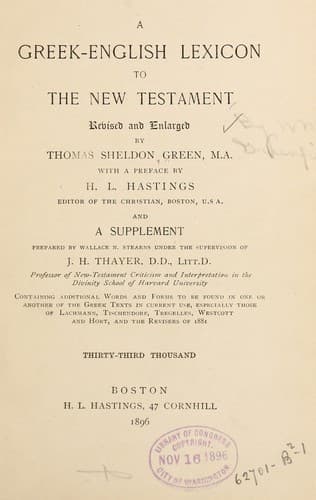
A Greek-English Lexicon to the New TestamentGreenfield, William
Religion
A Greek-English Lexicon to the New Testament
Greenfield, William
Bible. New Testament -- Dictionaries -- English; Greek language, Biblical -- Dictionaries -- English
Δαιμονίζομαι,
f. ίσομαι, a.1. ἐδαιμονίσθην,
in N.T. to be possessed, afflicted, vexed, by a demon, or
evil spirit; i.q. δαιμόνιον ἔχειν, Mat. 4.24; 8.16, 28, 33,
et al.:
from
Δαιμίνιον, ίου, τό, (δαίμων)
a heathen god, deity, Ac. 17.18. 1 Co. 10.20, 21. Re. 9.20;
in N.T., a demon, evil spirit, Mat. 7.22; 9.33, 34; 10.8; 12.24,
et al.:
whence
Δαιμονιώδης, εος, ὁ, ἡ;
pertaining to or proceeding from demons; demoniacal, devilish,
Ja. 3.15. L.G.
Δαίμων, ονος, ὁ, ἡ,
a god, a superior power; in N.T. a malignant demon, evil angel,
Mat. 8.31. Mar. 5.12. Lu. 8.29. Re. 16.14; 18.2.
Δάκνω,
f. δήξομαι, a.2. ἔδακον, p. δέδηχα,
to bite, string; met. to molest, vex, injure, Gal. 5.15.
Δάκρυ, υος, τό, & δάκρυον, ύου, τό,
a tear.
Δακρύω,
f. ὐσω, a.1. ἐδάκρυσο,
to shed tears, weep, Jno. 11.35 (ῡ)
Δακτύλιος, ου, ὁ,
a ring for the finger, Lu. 15.22:
from
Δάκτῠλος, ου, ὁ,
a finger, Mat. 28.4. Mar. 7.33, et al.; fr. Heb. power, Lu. 11.20.
Δαμάζω, (δαμάω, the same)
f. άσω, a.1. έδάμασο, p. pass. δεδάμασμαι,
to subdue, tame, Mar. 5.4. Ja. 3.7; met. to restrain within proper
limits, govern, Ja. 3.8. (μᾰ).
Δάμᾰλις, εως, ἡ,
a heifer, He. 9.13.
Δανείζω,
f. είσω, a.1. ἐδάνεισα,
to lend money, Lu. 6.34, 35; mid. to borrow money, Mat. 5.42:
from
Δάνειον, ου, τό, (δάνος, a gift, loan)
a loan, debt. Mat. 18.27.
Δανειστής, οῦ, ὁ, (δαωείζω)
a lender, creditor, Lu. 7.41. L.G.
Δαπανάω, ῶ,
f. ήσω, a.1. ἐδαπάνησα,
to expend, be at expense, Mar. 5.26. Ac. 21.24. 2 Co. 12.15;
to spend, waste, conosume by extravagance, Lu. 15.14. Ja. 4.3:
from
Δαπάνη, ης, ἡ,
expense, cost, Lu. 14.28. (πᾰ).
Δέ,
a conjunctive particle, marking the superaddition of a clause,
whether in opposition or in continuation, to what has preceded,
and it may be variously rendered but, on the other hand, and,
also, now, &c; καὶ δέ, when there is a special superaddition in
continuation, too, yea, &c. It sometimes is found at the
commencement of the apodosis of a sentence, Ac. 11.17. It serves
also to mark the resumption of an interrupted discourse,
2 Co. 2.10. Gal. 2.6
Δέησις, εως, ἡ, (δέομαι)
want, entreaty; prayer, supplication, Lu. 1.13; 2.37; 5.33,
et al.
Δεῖ,
imperson. fr. δέω, f. δεήσει, a.1. ἐδέησε, imperf. ἔδει,
subj. δέη, inf. δεῖν, part. δέον,
it is binding, it is necessary, it behoveth, it is proper;
it is inevitable, Ac. 21.22.
Δεῖγμα, ᾰτος, τό, (δείκνυμι)
pr. that which is shown, a speciment, sample; met. an example
by way of warning, Jude 7:
whence
Δειγματίζω,
f. ίσω, a.1. ἐδειγμάτισα,
to make a public show or spectacle of, Col. 2.15. N.T.
Δεικνύω, (ῠ) v. δείκνῡμι,
f. δείξω, a.1. ἔδειξα, a.1. pass. ἐδείχθην,
to show, point out, present to the sight, Mat. 4.8; 8.4, et al.;
to exhibit, permit to see, cause to be seen, Jno. 2.18; 10.32.
1 Ti. 6.15; to demonstrate, prove, Ja. 2.18; 3.13; met. to teach,
make known, declare, announce, Mat. 16.21. Jno. 5.20.
Public-domain text, read in full here on John Shaqi.
Reviews
Reviews
No reviews yet
Be the first to share your thoughts on this work.
Join the Discussion
Join the discussion
Sign in to leave a comment or review.
Sign InorCreate an account