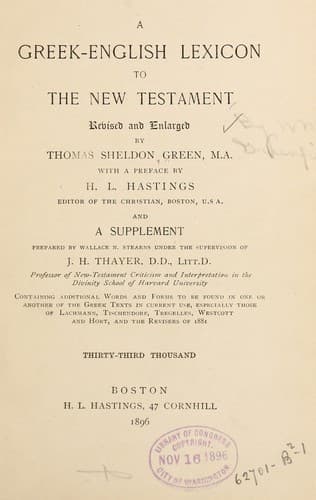
A Greek-English Lexicon to the New TestamentGreenfield, William
Religion
A Greek-English Lexicon to the New Testament
Greenfield, William
Bible. New Testament -- Dictionaries -- English; Greek language, Biblical -- Dictionaries -- English
Ac. 10.28,
et al.
Δειλία, ας, ἡ (δειλός)
timidity. 2 Ti. 1.7.
Δειλιάω, ῶ,
f. άσω,
to be timid, be in fear, Jno. 14.27: (L.G.) from
Δειλός, ή, όν,
timid, fearful, pusillanimous, cowardly, Mat. 8.26, Mar. 4.40.
Re. 21.8.
Δεῖνα, ὁ, ἡ, τό,
gen. δεῖνος, acc. δεῖνα,
such a one, a certain one, Mat. 26.18.
Δεινῶς, (δεινος, terrible, vehement)
adv. dreadfully, grievously, greatly, vehemently, Mat. 8.6.
Lu. 11.53.
Δειπνέω, ῶ,
f. ήσω & ήσομαι, a.1. ἐδείπνησα,
to sup, Lu. 17.8; 22.20. 1 Co. 11.25. Re. 3.20:
from
Δεῖπνον, ου, τό,
pr. a meal; supper, the principal meal taken in the evening,
Lu. 14.12. Jno. 13.2, 4, et. al.; meton. food, 1 Co. 11.21; a
feast, banquet, Mat. 23.6. Mar. 6.24, 12.39, et al.
Δεισιδαιμονία, ας, ἡ,
fear of the gods; in a bad sense, superstition; a form of religious
belief, Ac. 25.19: (L.G.)
from
Δεισιδαίμων, ονος, ὁ, ἡ, (δείδω, to fear, & δαίμων)
reverencing the gods and divine things, religious; in a bad sense,
superstitious; in N.T. careful and precise in the discharge of
religious services, Ac. 17.22.
Δέκα, οἱ, αἱ, τά,
ten, Mat. 20, 24; 25.1, et al.; ἡμερῶν δέκα, ten days, a few days,
a short time, Re. 2.10.
Δεκαδύο, οἱ, αἱ, τά, (δέκα & δύο)
i.q. δώδεκα, twelve, Ac. 19.7; 24.11.
Δεκαπέντε, οἱ, αἱ, τά, (δέκα & πέωτε)
fifteen, Jno. 11.18. Ac. 27.28. Gal. 1.18.
Δεκατέσσαρες, ων, οἱ, αἱ, & τὰ δεκατέσσαρα, (δέκα & τέσσαρες)
fourteen, Mat. 1.17. 2 Co. 12.2. Gal. 2.1
Δέκᾰτος, η, ον, (δέκα)
tenth, Jno. 1.40. Re. 11.13; 21.20; δεκάτη, sc. μερίς, a tenth part,
tithe, He. 7.2, 4, 8, 9:
whence
Δεκατόω, ῶ,
f. ώςω, p. δεδεκάτωκα,
to cause to pay tithes; pass to be tithed, pay tithes,
He. 7.6, 9. N.T.
Δεκτός, ή, όη, (δέχομαι)
accepted, acceptable, agreeable, approved, Lu. 4.24. Ac. 10.35.
Phi. 4.18; by impl. when used for a certain time, marked by a
favourable manifestation of the devine pleasure, propitious,
Lu. 4.19. 2 Co. 6.2. S.
Δελεάζω, (δέλεαρ, a bait,)
f. άσω,
pr. to entrap, take or catch with a bait; met. allure, entice,
delude, Ja. 1.14. 2 Pe. 14, 18.
Δένδρον, ου, τό,
a tree, Mat. 3.10; 7.17; 13.32.
Δεξιολάβος, ου, ὁ, (δεξιός & λαμβάνω)
one posted on the right hand; a flank guard; a light armed
spearman, Ac. 23.23. (ᾰ). N.T.
Δεξιός, ά, όν,
right, as opposed to left, dexter, Mat. 5.29, 30. Lu. 6.6,
et al.; ἡ δεξιά, sc. χείρ, the right hand, Mat. 6.3; 27.39,
et al.; τὰ δεξιά, sc. νέρη, the parts towards the right hand,
the right hand side; καθίζειν, v. καθῆσθαι, v. ἑστάναι,
ἐκ δεξιῶν (μερῶν) τινος, to sit or stand at the right hand of
any one, to enjoy with any one the highest honour and dignity
which he can bestow, Mat. 20.21; 26.64, et al.; εἶνοι ἐκ δεξιῶν
(μερῶν) τινος, to be at one's right hand, to be one's helper,
to afford aid to any one, Ac. 2.25; δεξιὰς (χεῖρας) διδόναι,
to give the right hand to any one, as a pledge of sincerity in
one's promises, Gal. 2.9.
Δέομαι,
see δέω.
Δίον, οντος, τό, (part.
Public-domain text, read in full here on John Shaqi.
Reviews
Reviews
No reviews yet
Be the first to share your thoughts on this work.
Join the Discussion
Join the discussion
Sign in to leave a comment or review.
Sign InorCreate an account