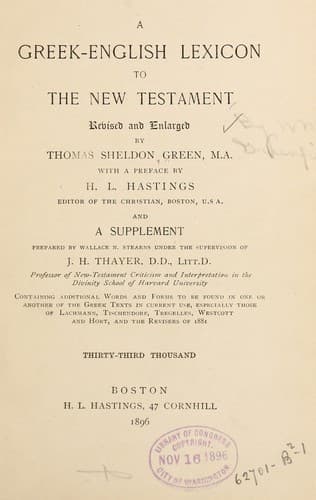
A Greek-English Lexicon to the New TestamentGreenfield, William
Religion
A Greek-English Lexicon to the New Testament
Greenfield, William
Bible. New Testament -- Dictionaries -- English; Greek language, Biblical -- Dictionaries -- English
5.7; 8.8, et al.;
of state or condition, in a state of, Ro. 4.11, et al.;
with an accusative, used of causation which is not direct
and immediate in the production of a result, on account of,
because of, for the sake of, with a view to, Mar. 2.27.
Jno. 1.31, et al.; rearely, through, while subjected to
a state of untoward circumstances, Gal. 4.13.
Διαβαίνω, (διά & βαίνω)
f. βήσομαι, a.2 διέβην,
to pass through or over, Lu. 16.26. Ac. 16.9. He. 11.29.
Διαβάλλω, (διά & βάλλω)
f. βαλῶ,
to throw or convey through or over to thrust through;
to defame, to inform against, Lu. 16.1.
Διαβεβαιόομαι, (διά & βεβαιόω)
to assert strongly, asseverate, 1 Ti. 1.7. Tit. 3.8.
Διαβλέπω, (διά & βλέπω)
f. ψω,
to look through; to view steadily; to see clearly or
steadily, Mat. 7.5. Lu. 6.42.
Διάβολος, ου, ὁ, ἡ, (διαβάλλω)
to calumniator, slanderer, 1 Ti. 3.11. 2 Ti. 3.3. Tit. 2.3;
a treacherous informer, traitor, Jno. 6.70; ὁ διάβολος,
the devil.
Διαγγέλλω, (διά & ἀγγέλλω)
f. γελῶ, a.1. διήγγειλα, a.2. pass διηγγέλην,
to publish abroad, Lu. 9.60. Ro. 9.17; to certify to the
public, Ac. 21.26; to tell, announce, give notice of, divulge,
publish abroad, Ac. 21.26; to declare, promulgate, teach,
Lu. 9.60; fr. the Heb. to celebrate, priase, Ro. 9.17.
Διαγίηομαι, (διά & γίνομαι)
f. γενήσομαι, a.2. διεγενόμην,
to continue through; to intervene, elapse, Mar. 16.1.
Ac. 25.13; 27.9.
Διαγινώσκω, (διά & γινώσκω)
f. γνώσομαι,
pr. to distinguish; to resolve determinately; to examine,
inquire into, judicially, Ac. 23.15; 24.22.
Διαγνωρίζω, (διά & γνωρίζω
f. ίσω,
to tell abroad, publish, Lu. 2.17. N.T.
Διάγνωσις, εως, ἡ (διαγινώσκω)
pr. an act of distingishing or discernment; a determination;
examination judicially, hearing, trial, Ac. 25.21.
Διαγογγύζω, (διά & γογγύζω)
f. ύσω,
to murmur, mutter, Lu. 15.2; 19.7. L.G.
Διαγρηγορέω, ῶ (διά & γρηγορέω)
to remain awake; to wake thoroughly, Lu. 9.32. L.G.
Διάγω, (διά & ἄγω)
f. ξω,
to conduct or carry through or over; to pass or spend
time, live, 1 Ti. 2.2. Tit. 3.3.
Διαδέχομαι, (διά & δέχομαι)
f. δέξομαι,
to receive by transmission; to receive by succession,
Ac. 7.45.
Διάδημα, ατος, τό, (διαδέω, διά & δέω)
pr. a band or fillet; a diadem, the badge of a sovereign,
Re. 12.3; 13.1; 19.12
Διαδίδωμι, (διά & δίδωμι)
f. δώσω, a.1. διέδωκα,
to deliver from hand to hand; to distribute, divide,
Lu. 11.22; 18.22. Jno. 6.11. Ac. 4.35.
Διάδοχος, ου, ὁ, ἡ, (διαδέχομαι)
a successor, Ac. 24.27.
Διαζώννῡμι, v. ζωννύω, (διά & ζώννυμι)
f. ζώσω, p. pass. διέζωσμαι,
to gird firmly round, Jno. 13.4, 5; mid. to gird round
one's self, Jno. 21.7.
Διαθήκη, ης, ἡ, (διατίθημι)
a testamentary disposition, will; a covenant,
He. 9.16, 17. Gal. 3.15; in N.T., a covenant of God with men,
Gal. 3.17; 4.24. He. 9.4. Mat. 26.28, et al.; the writings
of the old conenant, 2 Co. 3.14.
Διαίρεσις, εως, ἡ,
Public-domain text, read in full here on John Shaqi.
Reviews
Reviews
No reviews yet
Be the first to share your thoughts on this work.
Elsewhere in the archive
Join the Discussion
Join the discussion
Sign in to leave a comment or review.
Sign InorCreate an account