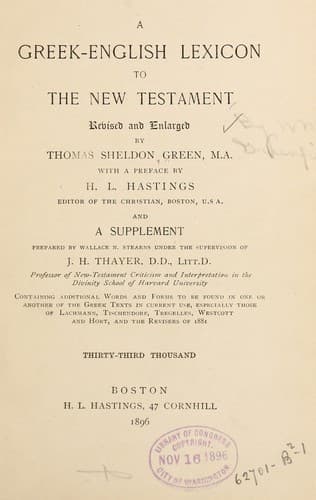
A Greek-English Lexicon to the New TestamentGreenfield, William
Religion
A Greek-English Lexicon to the New Testament
Greenfield, William
Bible. New Testament -- Dictionaries -- English; Greek language, Biblical -- Dictionaries -- English
10.40, 41; 18.5, et al.; to receive in
hospitality, entertain, Lu. 9.53. He. 11.31; to bear with,
bear patiently, 2 Co. 11.16; met. to receive, approve,
assent to, Mat. 11.14. Lu. 8.13. Ac. 8.14; 11.1, et al.;
to admin, and by impl. to embrace, follow, 1 Co. 2.14.
2 Co. 8.17, et al.
Δέω,
f. δήσω, p. δέδεκα, a.1. ἔδησα, p. pass. δέδεμαι,
a.1. pass. ἐδέθην,
to bind, tie, Mat. 13.30; 21.2, et al.; to bind, confine,
Mat. 27.2; 14.3, et al.; to impede, hinder, 2 Ti. 2.9;
to affect with disease, Lu. 13.16; to bind by a legal or
moral tie, as marriage, Ro. 7.2. 1 Co. 7.27, 39;
by impl. to impel, compel, Ac. 20.22; in N.T.,
to pronounce or declare any thing to be binding or
obligatory; or, to declare any thing prohibited and
unlawful, Mat. 16.19; 18.18.
Δέω,
f. δεήσω, a.1. ἐδέησα,
to lack, fall short of;
mid. δέομαι, f. δεήσομαι, a.1. ἐδεήθην,
to be in want, to need; to ask, request, Mat. 9.38.
Lu. 5.12; 8.23, 38, et al.; in N.T. absol. to pray, offer
prayer, beseech, supplicate, Lu. 21.36; 22.32. Ac. 4.31;
8.22, 24, et al.
Δή,
a particle serving to add an intensity of expression
to a term or clause. Its simplest and most ordinary uses
are when it gives impressiveness to an affirmation,
indeed, really, doubtless, Mat. 13.23. 2 Co. 12.1,
or earnestness to a call, injunction or entreaty,
Lu. 2.15. Ac. 13.2; 15.36. 1 Co. 6.20.
Δῆλος, η, ον,
pr. clearly visible; plain, manifest, evident,
Mat. 26.73. 1 Co. 15.27. Gal. 3.11. 1 Ti. 6.7:
whence
Δηλόω, ῶ
f. ώσω, a.1. ἐδήλωσα,
to render manifest or evident; to make known, to tell,
relate, declare, 1 Co. 1.11. Col. 1.8; to show, point out,
bring to light, 1 Co. 3.13, to intimate, signify,
He. 9.8; 12.27; 1 Pe. 1.11.
Δημηγορέω, ῶ, (δῆμος, & ἀγορεύω)
f. ήσω,
to address a public assembly, to deliver an harangue or
public oration, Ac. 12.21.
Δημιουργός, οῦ, ὁ, (δῆμος, & ἔργον)
pr. one who labours for the public, or, exercises some
public calling; an architect, especially the Divine
Architect of the universe, He. 11.10.
Δῆμος, ου, ὁ,
the people, Ac. 12.22; 17.5; 19.30, 33:
whence
Δημόσιος, ία, ον,
public, belonging to the public, Ac. 5.18; δημοσίᾳ,
publicly, Ac. 16.37; 18.28; 20.20.
Δηνάριον, ίου, τό,
Lat. denarius, a Roman silver coin. The silver denarius
was at first equivalent to about 8 ½d. of English money,
declining, under the empire, to about 7 ½d., and was
therefore somewhat less than the Greek δραχμή. The name
originally imported ten ases.
Δήποτε,
an intensive combination of the particle δή with πότε;
which see; as an intensive, Jno. 5.4.
Δήπου,
see που.
Διά,
prep., with a genitive, through, used of place or medium,
Mat. 7.13. Lu. 6.1. 2 Co. 11.33. et al.; through, of time,
during, in the course of, He. 2.15. Ac. 5.19, et al.;
through, of immediate agency, causation, instrumentality,
by means of, by, Jno. 1.3. Ac. 3.18, et al.; of means or
manner, throught, by, with Lu. 8.4. 2 Co.
Public-domain text, read in full here on John Shaqi.
Reviews
Reviews
No reviews yet
Be the first to share your thoughts on this work.
Elsewhere in the archive
Join the Discussion
Join the discussion
Sign in to leave a comment or review.
Sign InorCreate an account