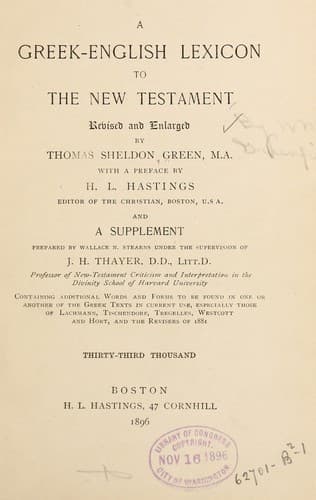
A Greek-English Lexicon to the New TestamentGreenfield, William
Religion
A Greek-English Lexicon to the New Testament
Greenfield, William
Bible. New Testament -- Dictionaries -- English; Greek language, Biblical -- Dictionaries -- English
termed the dispersion, Jno. 7.35. Ja. 1.1.
1 Pe. 1.1. L.G.
Διαστέλλω, (διά & στέλλω)
to separate, distinguish;
mid. διαστέλλομαι, a.1. διεστειλάμην,
to determine, issue a decision; to state or explain
distinctly and accurately; hence, to admonish, direct, c
harge, command, Ac. 15.24. He. 12.20; when followed by
a negative clause, to interdict, prohibit, Mat. 16.20.
Mar. 5.43, et al.
Διάστημα, ατος, τό, (διΐστημι)
interval, space, distance, Ac. 5.7.
Διαστολή, ῆς, ἡ (διαστέλλω)
distinction, difference, Ro. 3.22; 10.12.
1 Co. 14.7. L.G.
Διαστρέφω, (διά & στρέφω)
f. ψω, p. pass. διέστραμμαι,
to distort, turn awry; met. to pervert, corrupt,
Mat. 17.17. Lu. 9.41, et al.; to turn out of the way,
cause to make defection, Lu. 23.2. Ac. 13.8;
διεστραμμένος, perverse, corrupt, erroneous.
Διασώζω, (διά & σώζω)
f. σῶσω, a.1. pass. διασώθην,
to bring safe through; to convey in safety, Ac. 23.24;
pass. to reach a place or state of safety, Ac. 27.44; 28.1, 4.
1 Pe. 3.20; to heal, to restore to health, Mat. 14.36. Lu. 7.3.
Διατᾰγή, ῆς, ἡ, (διατάσσω)
an injunction, institute, ordiance, Ro. 13.2. Ac. 7.53. L.G.
Διάταγμα, ατος, τό, (fr. same)
a mandate, commandment, ordinance, He. 11.23. L.G.
Διαταράσσω, (διά & ταράσσω)
f. ξω,
to throw into a state of perturbation, to move or trouble
greatly, Lu. 1.29.
Διατάσσω, (διά & τάσσω)
f. ξω, & mid. διατάσσομαι,
pr. to arrange, make a precise arrangement; to prescribe,
1 Co. 11.34; 16.1. Tit. 1.5; to direct, Lu. 8.55. Ac. 20.13;
to charge, Mat. 11.1; to command, Ac. 18.2, et al.; to ordain,
Gal. 3.19.
Διατελέω, ῶ, (διά & τελέω)
f. έσω,
to complete, finish; intrans. to continue, persevere, in a
certain state or course of action, Ac. 27.33.
Διατηρέω, ῶ, (διά & τηρέω)
f. ήσω,
to watch carefully, guard with vigilance; to treasure up,
Lu. 2.51; εαυτὸν ἐκ, to keep one's self from, to abstain
wholly from, Ac. 15.29.
Διατί, i.e. διὰ τί,
interrog. for what? why? wherefore? Mat. 9.14; 13.16.
Lu. 19.23, 31.
Διατίθημι, (διά & τίθημι)
to arrange; mid. διατίθεμαι, f. θήσομαι, a.2. διεθέμην,
to arrange according to one's own mind; to make a disposition,
to make a will; to settle the terms of a convenant, to ratify,
Ac. 3.25. He. 8.10; 10.16; to assign, Lu. 22.29.
Διατρίβω, (διά & τρίβω)
f. ψω,
pr. to rub, wear away by friction; met. to pass or spend time,
to remain, stay, tarry, continue, Jno. 3.22; 11:54.
Ac. 12.19; 14.3, 28, et al. (ῑ).
Διατροφή, ῆς, ἡ, (διατρέφω, to nourish)
food, sustenance, 1 Ti. 6.8.
Διαυγάζω, (διά & αὐγάζω)
f. άσω,
to shine through, shine out, dawn, 2 Pe. 1.19. L.G.
Διαυγής, έος, οῦς, ὁ, ἡ, (διά & αὐγή)
translucent, transparent, pellucid, v.r. Re. 21.21.
Διαφᾰνής, έος, οῦς, ὁ, ἡ (διαφαίνω, to show through)
transparent, pellucid, Re. 21.21.
Διαφέρω, (διά & φέρω)
f. οίσω, a.1. ήνεγκα, a.2. ήνεγκον,
to convey through, across, Mar. 11.16; to carry different
Public-domain text, read in full here on John Shaqi.
Reviews
Reviews
No reviews yet
Be the first to share your thoughts on this work.
Elsewhere in the archive
Join the Discussion
Join the discussion
Sign in to leave a comment or review.
Sign InorCreate an account