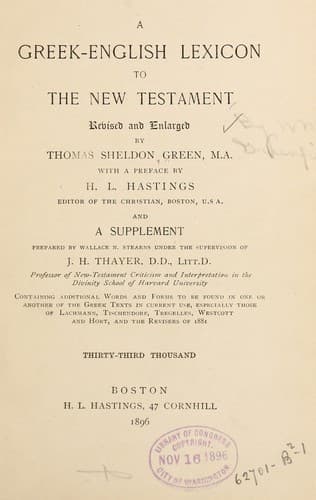
A Greek-English Lexicon to the New TestamentGreenfield, William
Religion
A Greek-English Lexicon to the New Testament
Greenfield, William
Bible. New Testament -- Dictionaries -- English; Greek language, Biblical -- Dictionaries -- English
ways or into different parts, separate; pass. to be borne,
driven, or tossed hither and thither, Ac. 27.27; to be
promulated, proclaimed, published, Ac. 13.49;
intrans. Met. to differ, 1 Co. 15.41; to excel, be better
or of greater value, be superior, Mat. 6.26; 10.31, et al.;
impers. διαφέρει, it makes a difference, it is of consequence;
with οὐδέν, it makes no difference, it is nothing, Gal. 2.6.
Διαφεύγω, (διά & φεύγω)
f. ξομαι, a.2. διέφυγον,
to flee through, escape by flight, Ac. 27.42.
Διαφημίζω, (διά & φημή)
f. ίσω, a.1. διεφήμισα,
to report, proclaim, pulblish, spread abroad, Mat. 9.31; 28.15.
Mar. 1.45.
Διαφθείρω, (διά & φθείρω)
f. φθερῶ, a.1. διέφθειρα, p. διέφθαρκα, a.2. pass. διεφθάρην,
p. pass. διέφθαρμαι,
to corrupt or destroy utterly; to waste, bring to decay,
Lu. 12.33. 2 Co. 4.16; to destroy, Re. 8.9; 11.18;
met. to corrupt, pervert utterly, 1 Ti. 6.5:
whence
Διαφθορά, ᾶς, ἡ
corruption, dissolution, Ac. 2.27, 31; 13.34, 35, 36, 37.
Διάφορος, ου, ὁ, ἡ, (διαφέρω)
different, diverse, of different kinds, Ro. 12.6. He. 9.10;
excellent, superior, He. 1.4; 8.6.
Διαφυλάσσω, (διά & φυλάσσω)
f. ξω,
to keep or guard carefully or with vigilance; to gard,
protect, Lu. 4.10.
Διαχειρίζω & διαχειρίζομαι, (διά & χείρ)
pr. to have in the hands, to manage; mid., later, to kill,
Ac. 5.30; 26.21.
Διαχλευάζω, (διά & χλευάζω)
f. άσω,
to jeer outright, deride, v.r. Ac. 2.13.
Διαχωρίζομαι, (mid. of διαχωρίζω, to separate, fr. διά & χωρίζω)
to depart, go away, Lu. 9.33.
Διδακτικός, ή, όν, (διδάσκω)
apt or qualified to teach, 1 Ti. 3.2. 2 Ti. 2.24. N.T.
Διδακτός, ή, όν, (fr. same)
pr. taught, teachable, of things; in N.T., taught, of persons,
Jno. 6.45. 1 Co. 2.13.
Διδασκαλία, ας, ἡ,
the act or occupation of teaching, Ro. 12..7. 1 Ti. 4.13, et al.;
information, instruction, Ro. 15.4. 2 Ti. 3.16;
matter taught, precepts, doctrine, Mat. 15.9. 1 Ti. 1.10, et al.:
from
Διδάσκᾰλος, ου, ὀ,
a teacher, master, Ro. 2.20, et al.; in N.T. as an equivalent
to ῤαββί, Jno. 1.39, et al.
Διδάσκω,
f. διδάξω, p. δεδίδαχα, a.1. ἐδίδαξα, a.1. pass. ἐδιδάχθην,
to teach, Mat. 4.23; 22.16, et al.; to teach or speak in a public
assembly, 1 Ti. 2.12; to direct, admonish, Mat. 28.15. Ro. 2.21,
et al.:
whence
Διδαχή, ῆς, ἡ,
instruction, the giving of instruction, teaching,
Mar. 4.2; 12.38, et al.; instruction, what is taught,
doctrine, Mat. 16.12. Jno. 7.16, 17, et al.;
meton. mode of teaching and kind of doctrine taught,
Mat. 7.28. Mar. 1.27.
Δίδραχμον, ου, τό, (δίς & δραχμή)
a didrachmon, or double drachm, a silver coin equal to the
drachm of Alexandria, to two Attic drachms, to two Roman
denarii, and to the half-shekel of the Jews, in value about
15d. halfpenny of our money, Mat. 7.24. bis.
Διδῠμος, ου, ὁ, ἡ, (δύο)
twofold, a twin; the Greek equivalent to the name Thomas,
Jno. 11.16; 20.24; 21.2.
Δίδωμι,
f. δώσω, p. δέδωκα, a.1. ἔδωκα, a.2. ἔδων, p.
Public-domain text, read in full here on John Shaqi.
Reviews
Reviews
No reviews yet
Be the first to share your thoughts on this work.
Elsewhere in the archive
Join the Discussion
Join the discussion
Sign in to leave a comment or review.
Sign InorCreate an account