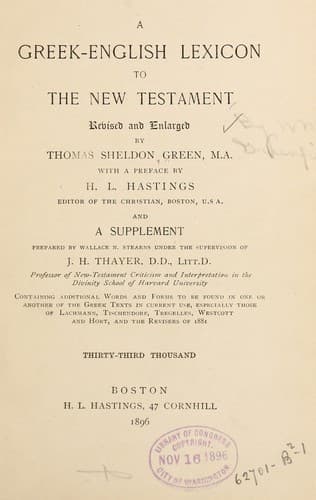
A Greek-English Lexicon to the New TestamentGreenfield, William
Religion
A Greek-English Lexicon to the New Testament
Greenfield, William
Bible. New Testament -- Dictionaries -- English; Greek language, Biblical -- Dictionaries -- English
Δοχή, ῆς, ἡ, (δέχομαι)
pr. reception of guests; in N.T., a banquet, feast, Lu. 5.29; 14.13.
Δράκων, οντος, ὁ,
a dragon or large serpent; met. the devil or Satan,
Re. 12.3, 4, 7, 9, 13, 16, 17; 13.2, 4, 11; 16.13; 20.2.
Δράσσομαι, (δράξ, the fist)
pr. to grasp with the hand, clutch; to lay hold of, seize,
take, catch, 1 Co. 3.19.
Δραχμή, ῆς, ἡ,
a drachm, an Attic silver coin of nearly the same value as the
Roman denarius, about 7¾d. of our money, Lu. 15.8, 9.
Δρέπᾰνον, ου, τό, (δρέπω, to crop, cut off)
an instrument with a curved blade, as a sickle, Mar. 4.29.
Re. 14.14, 15, 16, 17, 18, 19.
Δρόμος, ου, ὁ, (δέδρομα)
a course, race, race-course; met. course of life or ministry,
career, Ac. 13.25; 20.24. 2 Ti. 4.7.
Δύναμαι,
f. δυνήσομαι, imperf. ἐδθνάμην, & ἠδυνάμν,
a.1. ἐδυνησάμην, & ἐδυνάσθην, ἐδυνήθην, ἡδυνήθην,
to be able, either intrinsically and absolutely,
which is the ordinary signification; or, for specific
reasons, Mat. 9.15. Lu. 16.2.
Δύναμις, εως, ἡ
power; strength, ability, Mat. 25.15. He. 11.11; efficacy,
1 Co. 4.19, 20. Phi. 3.10. 1 Thes. 1.5. 2 Ti. 3.5; energy,
Col. 1.29. 2 Ti. 1.7; meaning, purport of language, 1 Co. 14.11;
authority, Lu. 4.36; 9.1; might, power, majesty, Mat. 22.29; 24.30.
Ac. 3.12. Ro. 9.17. 2 Thes. 1.7. 2 Pe. 1.16; in N.T.,
a manifestation or instance of power, mighty means,
Ac. 8.10. Ro. 1.16. 1 Co. 1.18, 24; ἡ δύναμις, omnipotence,
Mat. 26.64. Lu. 22.69. Mar. 14.62; pl. authorities, Ro. 8.38.
Ep. 1.21. 1 Pe. 3.22; miraculous power, Mar. 5.30.
Lu. 1.35; 5.17; 6.19; 8.46; 24.49. 1 Co. 2.4; a miracle,
Mat. 11.20, 21, et al. freq.; a worker of miracles,
1 Co. 12.28, 29; fr. the Heb. αἱ δυνάμεις τῶν οὐρανῶν,
the heavenly luminaries, Mat. 24.29. Mar. 13.25. Lu. 21.26;
αἱ δυνάμεις, the spiritual powers, Mat. 14.2. Mar. 6.14:
whence
Δυναμόω, ῶ,
f. ώσω,
to strengthen, confirm, Col. 1.11. L.G.
Δυνάστης, ου, ὁ,
a potentate, sovereign, prince, Lu. 1.52. 1 Ti. 6.15; a person
of rank and authority, a grandee, Ac. 8.27.
Δυνατέω, ῶ,
f. ήσω,
to be powerful, mighty, to show one's self powerful, 2 Co. 13.3.
v.r. Ro. 14.4. (N.T.):
from
Δυνατός, ή, όν, (δύναμαι)
able, having power, powerful, mighty, δυνατὸς εἴναι, to be
able, i.q. δύνασθας, Lu. 14.31. Ac. 11.17, et al.; ὀ δυνατός,
the Mighty One, God, Lu. 1.49; τὸ δυνατόν, power, i.q. δύναμις,
Ro. 9.22; valid, powerful, efficacious, 2 Co. 10.4; distinguished
for rank, authority or influence, Ac. 25.5. 1 Co. 1.26;
distinguished for skill or excellence, Lu. 24.19. Ac. 7.22.
Ro. 15.1; δυνατόν & δυνατά, possible, capable of being done,
Mat. 19.26; 24.24, et al.
Δύνω,
a.2. ἔδυν,
to sink, go down, set as the sun, Mar. 1.32. Lu. 4.40.
Δύο,
both indeclin. & also gen. and dat. δυοῖν, v. gen. δυῶν,
dat. δυσί; in N.T., both indeclin. and also with dat. δυσί,
two, Mat. 6.24; 21.28, 31, et al. freq.; οἱ δύο, both, Jno. 20.4;
δύο ἢ τρεῖς, two or three, some, a few, Mat. 18.20; from the
Public-domain text, read in full here on John Shaqi.
Reviews
Reviews
No reviews yet
Be the first to share your thoughts on this work.
Elsewhere in the archive
Join the Discussion
Join the discussion
Sign in to leave a comment or review.
Sign InorCreate an account