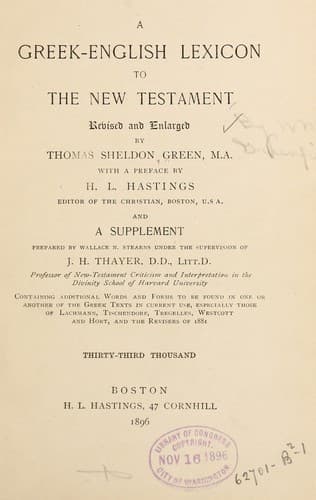
A Greek-English Lexicon to the New TestamentGreenfield, William
Religion
A Greek-English Lexicon to the New Testament
Greenfield, William
Bible. New Testament -- Dictionaries -- English; Greek language, Biblical -- Dictionaries -- English
to begin to exist, come into existence, Ro. 5.12. 2 Jno. 7; or to
make one's appearance on earth, He. 10.5; to enter into or take
possession of, Lu. 22.3. Jno. 13.27; to enter into, enjoy, partake
of, Mat. 19.23, 24, et al.; to enter into any one's labour, be his
successor, Jno. 4.38; to fall into, be placed in certain circumstances,
Mat. 26.41, et al.; to be put into, Mat. 15.11. Ac. 11.8; to present
one's self before, Ac. 19.30; met. to arise, spring up, Lu. 9.46;
fr. the Heb. εἰσέρχεσθαι καὶ ἐξέρχεσθαι, to go in and out, to live,
discharge the ordinary functions of lie, versari, Ac. 1.21.
Εἰσκαλέω, ῶ, (εἰς & καλέω)
f. έσω, & mid. εἰσκαλέομαι, οῦμαι,
to call in; to invite in, Ac. 10.23.
Εἴσοδος, ου, ἡ, (εἰς & ὅδος)
a place of entrance; the act of bringing in or introducing; admission,
reception, 1 Thes. 1.9. He. 10.19. 2 Pe. 1.11; a coming, approach,
access, 1 Thes. 2.1; entrance upon office, commencement of official
duties, Ac. 13.24.
Εἰσπηδάω, ῶ, (εἰς & πηδάω, to leap)
f. ήσω,
to leap or spring in, rush in eagerly, Ac. 14.14; 16.29.
Εἰσπορεύομαι, (εἰς & πορεύομαι)
f. εύσομαι,
to go or come in, enter, Mar. 1.21; 5.40, et al.; to come to,
visit, Ac. 28.30; to be put in, Mat. 15.17. Mar. 7.15, 18, 19;
to intervene, Mar. 4.19; fr. the Heb. εἰσπορεύεσθαι καὶ ἐκπορεύεσθαι,
equivalent to εἰσέρχεσθαι καὶ ἐξέρχεσθαι, above, Ac. 9.28.
Εἰστρέχω, (εἰς & τρέχω)
a.2. εἰσέδραμον,
to run in, Ac. 12.14.
Εἰσφέρω, (εἰς & φέρω)
f. οίσω, a.1. ήνεγκα, a.2. ήνεγκον,
to bring in, to, or into, Lu. 5.18, 19. 1 Ti. 6.7. He. 13.11; to
bring to the ears of any one, to announce, Ac. 17.20; to lead into,
Mat. 6.13. Lu.11.4.
Εἶτα,
adv. then, afterwards, thereupon, Mar. 4.17, 28. Lu. 8.12, et al.;
in the next place, 1 Co. 12.28; besides, He. 12.9.
Εἴωθα,
2. p. from an old pr. ἔθω with a present signification,
plup. εἰώθειν, part. εἰωθώς, to be accustomed, to be usual,
Mat. 27.15, et al.
Ἐκ, before a consonant, ἐξ before a vowel,
prep. from, out of, a place, Mat. 2.15; 3.17; of, from, out of,
denoting origin or source, Mat. 1.3; 21.19; of, from some material,
Mat. 3.9. Ro. 9.21; of, from, among, partitively, Mat. 6.27; 21.31.
Mar. 9.17; from, denoting cause, Re. 8.11; 17.6; means or instrument,
Mat. 12.33, 27; by, through, denoting the author or efficient cause,
Mat. 1.18. Jno. 10.32; of, denoting the distinguishing mark of a class,
Ro. 2.8. Gal. 3.7, et al.; of time, after, 2 Co. 4.6. Re. 17.11;
from, after, since, Mat. 19.12. Lu. 8.27; for, with, denoting a
rate of payment, price, Mat. 20.2; 27.7; at, denoting position,
Mat. 20.21, 23; after passive verbs, by, of, from, marking the
agent, Mat. 15.5. Mar. 7.11; forming with certain words a periphrasis
for an adverb, Mat. 26.42, 44. Mar. 6.51. Lu. 23.8; put after verbs
of freeing, Ro. 7.24. 2 Co. 1.10; used partitively after verbs of
eating, drinking, &c. Jno. 6.26. 1 Co. 9.7.
Ἕκαστος, η, ον,
each one, every one separately, Mat.
Public-domain text, read in full here on John Shaqi.
Reviews
Reviews
No reviews yet
Be the first to share your thoughts on this work.
Elsewhere in the archive
Join the Discussion
Join the discussion
Sign in to leave a comment or review.
Sign InorCreate an account