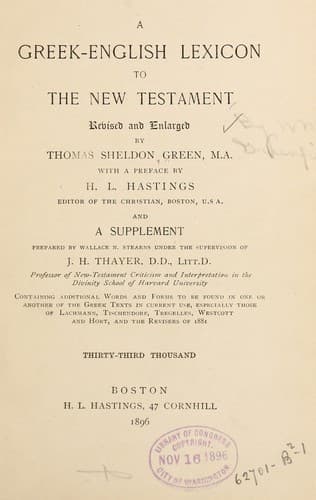
A Greek-English Lexicon to the New TestamentGreenfield, William
Religion
A Greek-English Lexicon to the New Testament
Greenfield, William
Bible. New Testament -- Dictionaries -- English; Greek language, Biblical -- Dictionaries -- English
Ἐκλαλέω, ῶ (ἐκ & λαλέω)
f. ήσω,
to speak out; to tell, utter, divulge, Ac. 23.22.
Ἐκλάμπω, (ἐκ & λάμπω)
f. ψω,
to shine out or forth, be resplendent, Mat. 13.43.
Ἐκλανθάνω, (ἐκ & λανθάνω)
to make to forget, quite; mid. ἐκλανθάνομαι, p. ἐκλέλησμαι,
to forget entirely, He. 12.5.
Ἐκλέγω,
f. ξε,
to pick out; in N.T., mid. ἐκλέγομαι, a.1. ἐξελεξάμην,
to choose, select, Lu. 6.13; 10.42, et al.; in N.T.,
to choose out as the receipients of special favour and
privilege, Ac. 13.17. 1 Co. 1.27, et al.
Ἐκλείπω, (ἐκ & λείπω)
f. ψω,
intrans., to fail, Lu. 22.32; to come to an end, He. 1.12;
to be defunct, die, Lu. 16.9.
Ἐκλεκτός, ή, όν, (ἐκλέγομαι)
chosen out, selected; in N.T., chosen as a recipient of
special privilege, elect, Col. 3.12, et al.; specially beloved,
Lu. 23.35; possessed of prime excellence, exalted, 1 Ti. 5.21;
choice, precious, 1 Pe. 2.4, 6.
Ἐκλογή, ῆς, ἡ, (same)
the act of choosing out, election; in N.T., election to privilege
by divine grace, Ro. 11.5, et al.; ἡ ἐκλογή, the aggregate of those
who are chosen, the elect, Ro. 11.7; ἐκλογῆς, equivalent to ἐκλεκτόν,
by Hebraism, Ac. 9.15.
Ἐκλύομαι, (ἐκλύω, to loosen, debilitate, ἐκ & λύω)
to be weary, exhausted, faint, Mat. 9.36; 15.32. Mar. 8.3.
Gal. 6.9; to faint, despond, He. 12.3, 5.
Ἐκμάσσω, (ἐκ & μάσσω)
f. ξω,
to wipe off; to wipe dry, Lu. 7.38, 44. Jno. 11.2; 12.3; 13.5.
Ἐκμυκτηρίζω, (ἐκ & μυκτηρίζω, fr. μυκτήρ, the nose)
f. ίσω,
to mock, deride, scoff at, Lu. 16.14; 23.35.
Ἐκνέω,
f. ἐκνεύσομαι, a.1. ἐξένευσα,
pr. to swim out, to escape by swimming; hence, generally,
to escape, get clear of a place, Jno. 5.18; though ἐκνεύσας,
in this place, may be referred to ἐκνεύω, to deviate, withdraw.
Ἐκνήφω, (ἐκ & νήφω)
f. ψω,
pr. to awake sober after intoxication; met. to shake off mental
bewilderment, to return to a right mode of thinking, feeling,
acting, &c. 1 Co. 15.34.
Ἑκούσιος, α, ον, & ου, ὁ, ἡ, (ἑκών)
voluntary, spontaneous, Phile. 14.
whence
Ἑκουσίως,
adv. voluntarily, spontaneously, He. 10.26. 1 Pe. 5.2.
Ἔκπᾰλαι, (ἐκ & πάλαι)
adv. of old, long since, 2 Pe. 2.3; 3.5. L.G.
Ἐκπειράζω, (ἐκ & πειράζω)
f. άσω,
to tempt, put to the proof, Mat. 4.7. Lu. 4.12. 1 Co. 10.9;
to try, sound, Lu. 10.25. L.G.
Ἐκπέμπω, (ἐκ & πέμπω)
f. ψω,
to send out, or away, Ac. 13.4; 17.10.
Ἐκπερισσῶς, (strengthened fr. περισσῶς)
adv. exceedingly, vehemently, v.r. Mar. 14.31.
Ἐκπετάννῡμι, (ἐκ & πετάννυμι)
f. άσω,
to stretch forth, expand, extend, Ro. 10.21. (ᾱ)
Ἐκπηδάω, ῶ, (ἐκ & πηδάω, to leap, spring)
f. ήσω,
to leap forth, rush out, v.r. Ac. 14.14.
Ἐκπίπτω,
f. πεσοῦμαι, p. πέπτωκα, a.1. εξέπεσα, a.2. ἐξέπεσον,
to fall off or from, Mar. 13.25. Ac. 12.7; 27.32, et al.;
met. to fall from, forfeit, lose, Gal. 5.4. 2 Pe. 3.17. Re. 2.5;
to be cast ashore, Ac. 27.17, 26, 29; to fall to the ground, be
fruitless, ineffectual, Ro. 9.6; to cease, come to an end,
1 Co.
Public-domain text, read in full here on John Shaqi.
Reviews
Reviews
No reviews yet
Be the first to share your thoughts on this work.
Elsewhere in the archive
Join the Discussion
Join the discussion
Sign in to leave a comment or review.
Sign InorCreate an account