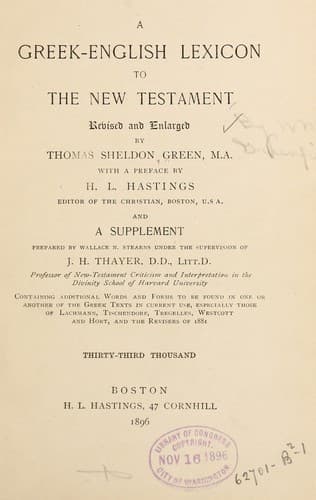
A Greek-English Lexicon to the New TestamentGreenfield, William
Religion
A Greek-English Lexicon to the New Testament
Greenfield, William
Bible. New Testament -- Dictionaries -- English; Greek language, Biblical -- Dictionaries -- English
15.27; ἐκτὸς εἰ μή,
unless, except, 1 Co. 14.5, et al.
Ἐκτρέπω, (ἐκ & τρέπω)
f. ψω, a.2. pass. ἐξετράπην,
to turn out or aside, He. 12.13; mid. to turn away or aside,
swerve, 1 Ti. 1.6; 5.15. 2 Ti. 4.4; to turn from, avoid,
1 Ti. 6.20.
Ἐκτρέφω, (ἐκ & τρέφω)
f. ἐκθρέψω,
to nourish, promote health and strength, Ep. 5.29; to bring
up, educate, Ep. 6.4.
Ἔκτρωμα, ατος, τό, (ἐκτιτρώσκω, to cause abortion)
an abortion, fœtus prematurely born, 1 Co. 15.8.
Ἐκφέρω, (ἐκ & φέρω)
f. ἐξοίσω, a.1. ἐξήνεγκα, a.2 ἐξήνεγκον,
to bring forth, carry out, Lu. 15.22. Ac. 5.15. 1 Ti. 6.7;
to carry out for burial, Ac. 5.6, 9, 10; to produce, yield,
He. 6.8.
Ἐκφεύγω, (ἐκ & φεύγω)
f. ξομαι, a.2. ἐξέφυγον, p. ἐκπέφευγα,
intrans., to flee out, to make an escape, Ac. 16.27; 19.16;
trans., to escape, avoid, Lu. 21.36. Ro. 2.3, et al.
Ἐκφοβέω, ῶ, (ἐκ & φοβέω)
f. ήσω,
to terrify, 2 Co. 10.9
Ἔκφοβος, ου, ὁ, ἡ, (ἐκ & φόβος)
affrighted, Mar. 9.6. He. 12.21.
Ἐκφύω, (ἐκ & φύω)
f. ύσω,
to generate; to put forth, shoot, Mat. 24.32. Mar. 13.28. (ῠ, ῡσ–)
Ἐκχέω,
f. ἐκχέω, or ἐκχεῶ, a.1. ἐξέχεα, p. ἐκκέχῠκα, pass. p. ἐκκέχῠμαι,
a.1. ἐξεχύθην,
to pour out, Re. 16.1, 2.3, et al.; to shed blood, Mat. 26.28.
Mar. 14.24, et al.; pass. to gush out, Ac. 1.18; to spill,
scatter, Mat. 9.17. Jno. 2.15; met. to give largely, bestow
liberally, Ac. 2.17, 18, 33; 10.45, et al.; pass. to rush headlong
into any thing, be abandoned to, Jude 11.
Ἐκχύνω,
a later form equivalent to ἐκχέω. Mat. 23.35, et al.
Ἐκχωρέω, ῶ, (ἐκ & χωρέω)
f. ήσω,
to go out, depart from, flee, Lu. 21.21.
Ἐκψύχω,
f. ξω,
to expire, give up the ghost, Ac. 5.5, 10; 12.23. (ῡ)
Ἑκών, οῦσα, όν,
willing, voluntary, Ro. 8.20. 1 Co. 9.17.
Ἐλαία, ας, ἡ,
an olive tree, Mat. 21.1; 24.3, et al.; an olive, fruit of
the olive tree, Ja. 3.12:
whence
Ἔλαιον, ου, τό,
olive oil, oil, Mat. 25.3, 4, 8. Mar. 6.13, et al.
Ἐλαιών, ῶνος, ὁ,
an olive garden; in N.T., the mount Olivet, Ac. 1.12.
Ἐλάσσων, v. ττως, ονος, ὁ, ἡ, τό, -ον, (comp. of old word ἐλαχύς)
less; less in age, younger, Ro. 9.12; less in dignity,
inferior, He. 7.7; less in quality, inferior, worse, Jno. 2.10:
whence
Ἔλαττον, (pr. neut. of preced.)
adv. less, 1 Ti. 5.9.
Ἐλαττονέω, ῶ,
f. ήσω, a.1. ἠλαττόνησα,
trans. to make less; intrans. to be less, inferior; to have
too little, want, lack, 2 Co. 8.15. L.G.
Ἐλαττόω, ῶ,
f. ώσω, p. pass. ἠλαττωμαι,
to make less or inferior, He. 2.7; pass. to be made less or
inferior, He. 2.9; to decline in importance, Jno. 3.30.
Ἐλαύνω,
f. ἐλάσω, p. ἐλήλακα,
to drive, urge forward, spur on, Lu. 8.29. Ja. 3.4. 2 Pe. 2.17;
to impel a vessel by oars, to row, Mar. 6.48. Jno. 6.19.
Ἐλαφρία, ας, ἡ,
lightness in weight; hence, lightness of mind, thoughtlessness,
levity, 2 Co. 1.17: (L.G.)
from
Ἐλαφρός, ά, όν,
light, not heavy, Mat. 11.30. 2 Co. 4.17.
Ἐλάχιστος, η, ον, (sup. of μικρός, fr. ἐλαχύς)
Public-domain text, read in full here on John Shaqi.
Reviews
Reviews
No reviews yet
Be the first to share your thoughts on this work.
Elsewhere in the archive
Join the Discussion
Join the discussion
Sign in to leave a comment or review.
Sign InorCreate an account