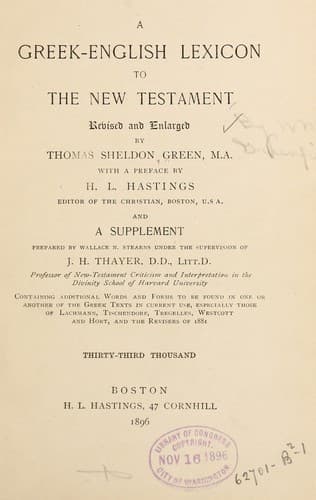
A Greek-English Lexicon to the New TestamentGreenfield, William
Religion
A Greek-English Lexicon to the New Testament
Greenfield, William
Bible. New Testament -- Dictionaries -- English; Greek language, Biblical -- Dictionaries -- English
to illude, delude, deceive,
Mat. 2.16:
whence
Ἐμπαίκτης, ου, ὁ,
a mocker, derider, scoffer, 2 Pe. 3.3. Jude 18. L.G.
Ἐμπεριπατέω, ῶ, (ἐν & περιπατέω)
f. ήσω,
pr. to walk about in a place; met. in N.T., to live among,
be conversant with, 2 Co. 6.16.
Ἐμπίπλημι, & ἐμπιπλάω, ῶ, (ἐν & πίμπλημι)
f. ἐμπλήσω, a.1. pass ἐνεπλήσθην,
to fill, Ac. 14.17; pass. to be satisfied, satiated, full,
Lu. 1.53; 6.25. Jno. 6.12; met. to have full enjoyment of,
Ro. 15.24.
Ἐμπίπρημι,
f. πρήσω,
to set on fire, to burn, Mat. 22.7.
Ἐμπίπτω, (ἐν & πίπτω)
f. πεσοῦμαι, a.2. ἐνέπεσον,
to fall into, Mat. 12.11. Lu. 14.5; to encounter, Lu. 10.36;
to be involved in, 1 Ti. 3.6, 7; 6.9; εἰς χεῖρας, to fall
under the chastisement of, He. 10.31.
Ἐμπλέκω, (ἐν & πλέκω)
f. ξω,
pr. to intertwine; met. to implicate, entangle, involve;
pass. to be implicated, involved, or to entangle one's self in,
2 Ti. 2.4. 2 Pe. 2.20.
Ἐμπλοκή, ῆς, ἡ, (ἐμπλέκω)
braiding or plaiting of hair, 1 Pe. 3.3. L.G.
Ἐμπνέω, (ἐν & πνέω)
f. εύσω,
to breathe into or upon; to respire, breathe; met. to breathe of,
be animated with the spirit of, Ac. 9.1.
Ἐμπορεύομαι, (ἐν & πορεύομαι)
f. εύσομαι,
to travel; to travel for business' sake; to trade, traffic,
Ja. 4.13; by impl. to make a gain of, deceive for one's own
advantage, 2 Pe. 2.3:
whence
Ἐμπορία, ας, ἡ,
traffic, trade, Mat. 22.5.
Ἐμπόριον,
a mart, market-place, emporium; meton. traffic, Jno. 2.16.
Ἔμπορος, ου, ὁ,
a passenger by sea; a traveller; one who travels about for
traffic, a merchant, Mat. 13.45. Re. 18.3, 11, 15, 23.
Ἔμπροσθεν,
adv., used also as a prep., before, in front of, Lu. 19.4.
Phi. 3.14; before, in the presence of, in the face of,
Mat. 5.24; 23.14; before, previous to, Jno. 1.15, 27, 30;
fr. the Heb. in the sight or estimation of, Mat. 11.26;
18.14, et al.
Ἐμπτύω, (ἐν & πτύω)
f. ύσω,
to spit upon, Mat. 26.67; 27.30, et al. (ῡω, ῠσω) L.G.
Ἐμφᾰνής, έος, οῦς, ὁ, ἡ, τό, -ές, (ἐν & φαίνω)
apparent, conspicuous, obvious to the sight, Ac. 10.40;
met. manifest, known, comprehended, Ro. 10.20:
whence
Ἐμφανίζω,
f. ίσω, a.1. ἐνεφάνισα,
to cause to appear clearly; to communicate, report,
Ac. 23.15, 22; to lay an information, Ac. 24.1; 25.2, 15;
to manifest, intimate plainly, He. 11.14; to reveal, make
known, Jno. 14.21, 22; pass. to appear, be visible,
Mat. 27.53; to present one's self, He. 9.24.
Ἔμφοβος, ου, ὁ, ἡ, (ἐν & φόβος)
terrible; in N.T., terrified, affrighted, Lu. 24.5, 37.
Ac. 10.4; 22.9, et al.
Ἐμφῡσάω, ῶ, (ἐν & φυσάω, to breathe)
f. ήσω,
to blow or breath into, inflate; in N.T., to breathe upon,
Jno. 20.22.
Ἔμφῠτος, ου, ὁ, ἡ, (ἐν & φύω)
implanted, ingrafted, infixed, Ja. 1.21.
Ἐν,
prep. pr. referring to place, in, Mat. 8.6. Mar. 12.26.
Re. 6.6, et al. freq.; upon, Lu. 8.32, et al.; among,
Mat. 11.11, et al.; before, in the presence of, Mar. 8.38,
et al.; in the sight, estimation of, 1 Co.
Public-domain text, read in full here on John Shaqi.
Reviews
Reviews
No reviews yet
Be the first to share your thoughts on this work.
Elsewhere in the archive
Join the Discussion
Join the discussion
Sign in to leave a comment or review.
Sign InorCreate an account