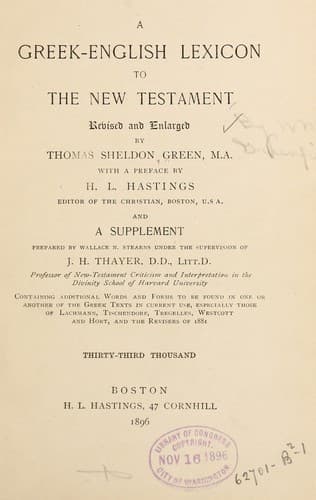
A Greek-English Lexicon to the New TestamentGreenfield, William
Religion
A Greek-English Lexicon to the New Testament
Greenfield, William
Bible. New Testament -- Dictionaries -- English; Greek language, Biblical -- Dictionaries -- English
an injunction; a precept, commandment, Mat. 5.19; 15.3, 6;
instruction in one's duties, 1 Ti. 6.14. 2 Pe. 2.21; a command,
direction, Jno. 10.18. Ac. 17.15; an edict, Jno. 11.57; a direction,
Mar. 10.5; a commission, instructions committed to any one to be
proclaimed, a charge, Jno. 12.49, 50, et al.
Ἐντόπιος, ου, ὁ, ἡ, (ἐν & τόπος)
i.q. ἔντοπος, in or of a place; an inhabitant, citizen,
Ac. 21.12.
Ἐντός, (ἐν)
adv. inside, within, Lu. 17.21; τὸ ἐντός, the interior,
inside, Mat. 23.26.
Ἐντρέπω, (ἐν & τρέπω)
f. ψω,
pr. to turn one back upon himself; hence, to put to shame,
make ashamed; mid. ἐντρέπομαι, f. ἐντραπήσομαι, a.2. ἐνετραπόμην,
to revere, revenence, regard, Mat. 21.37. Mar. 12.6, et al.;
absol. to feel shame, be put to shame, 2 Thes. 3.14. Tit. 2.8.
Ἐντρέφω, (ἐν & τρέφω)
f. ἐνθρέψω,
to nourish in, bring up or educate in; pass. to be imbued,
1 Ti. 4.6.
Ἔντρομος, ου, ὀ, ἡ, (ἐν & τρόμος)
trembling, terrifed, Ac. 7.32; 16.29. He. 12.21. L.G.
Ἐντροπή, ῆς, ἡ, (ἐντρέπω)
reverence; in N.T., shame, 1 Co. 6.5; 15.34.
Ἐντρυφάω, ῶ, (ἐν & τρυφάω)
f. ήσω,
to live luxuriously, riot, revel, 2 Pe. 2.13.
Ἐντυγχάνω, (ἐν & τυγχάνω)
f. τεύξομαι, a.2. ἐνετῠχον,
to fall in with, meet; to have converse with, address; to
address or apply to any one, Ac. 25.24; ὑμέρ τινος, to intercede
for any one, plead the cause of, Ro. 8.27, 34. He. 7.25;
κατά τινος, to address a representative or suit against any one,
to accuse, complain of, Ro. 11.2.
Ἐντυλίσσω, (ἐν & τυλίσσω)
f. ξω, p. pass. ἐντετύλιγμαι,
to wrap up in, inwrap, envelope, Mat. 27.59. Lu. 23.53; to wrap up,
roll or fold together, Jno. 20.7.
Ἐντυπόω, ῶ, (ἐν & τυπόω, fr. τύπος, an impress)
f. ώσω,
to impress a figure, instamp, engrave, 2 Co. 3.7.
Ἐνυβρίζω, (ἐν & ὕβρις)
f. ίσω,
to insult, outrage, contemn, He. 10.29.
Ἐνυπνιάζω,
f. άσω, & ἐνυπνιάζομαι, f. ἐνυπνιασθήσομαι,
to dream; in N.T., to receive some supernatural impression or
information in a dream, Ac. 2.17; to cherish vain opinions, Jude 8:
from
Ἐνύπνιον, ου, τό, (pr. neut. of ἐνύπνιος, presented during sleep,
fr. ἐν & ὕπνος)
a dream; in N.T., a supernatural suggestion or impression
receive during sleep, a vision, Ac. 2.17.
Ἐνώπιον, (pr. neut. of ἐνώπιος, in sight or front)
adv. before, in the presence of, Lu. 5.25; 8.47; in front of,
Re. 4.5, 6; immediately preceding as a forerunner, Lu. 1.17.
Re. 16.19; fr. the Heb. in the presence of, metaphysically,
i.e. in the sphere of sensation or thought, Lu. 12.9; 15.10.
Ac. 10.31; in the eyes of, in the judgment of, Lu. 16.15; 24.11.
Ac. 4.19, et al. L.G.
Ἐνωτίζομαιν, (ἐν & οὖς)
f. ίσομαι, a.1. ἐνωτισάμην,
to give ear, listen, hearken to, Ac. 2.14. L.G.
Ἐξ,
see ἐκ.
Ἕξ, οἱ, αἱ, τά,
six, Mat. 17.1. Mar. 9.2, et al.
Ἐξαγγέλλω, (ἐξ & ἀγγέλλω)
f. γελῶ
to tell forth, divulge, publish; to declare abroad,
celebrate, 1 Pe. 2.9.
Ἐξαγοράζω, (ἐξ & ἀγοράζω)
f. άσω,
Public-domain text, read in full here on John Shaqi.
Reviews
Reviews
No reviews yet
Be the first to share your thoughts on this work.
Elsewhere in the archive
Join the Discussion
Join the discussion
Sign in to leave a comment or review.
Sign InorCreate an account