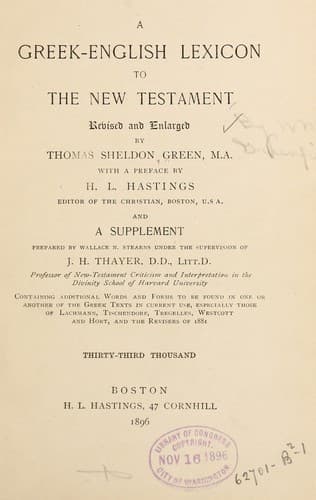
A Greek-English Lexicon to the New TestamentGreenfield, William
Religion
A Greek-English Lexicon to the New Testament
Greenfield, William
Bible. New Testament -- Dictionaries -- English; Greek language, Biblical -- Dictionaries -- English
19.17, 19; above, more than, Mar. 14.5, et al. (ᾰ)
Ἐπαρκέω, ῶ,(ἐπί & ἀρκέω)
f. έσω,
pr. to ward off; to assist, relieve, succour, 1 Ti. 5.10, 16, bis.
Ἐπαρχία, ας, ἡ, (ἔπαρχος, a prefect, &c.)
a prefecture, province, Ac. 23.34; 25.1. L.G.
Ἔπαυλις, εως, ἡ, (ἐπί & αὐλίζομαι)
pr. a place to pass the night in; a cottage; in N.T., a
dwelling, habitation, Ac. 1.20.
Ἐπαύριον, (ἐπί & αὔριον)
tomorrow; ἡ ἐπαύριον, sc. ἡμέρα, the next or following day,
Mat. 27.62. Mar. 11.12, et al.
Ἐπαυτοφώρῳ, (ἐπί & αὐτόφωρος, fr. αὐτός & φώρ, a thief)
adv. pr. in the very theft; in N.T., in the very act, Jno. 8.4.
Ἐπαφρίζω, (ἐπί & ἀφρίζω)
f. ίσω,
to foam out; to pour out like foam, vomit forth, Jude 13.
Ἐπεγείρω, (ἐπί & ἐγείρω)
f. γερῶ,
to raise or stir up against, excite or instigate against,
Ac. 13.50; 14.2.
Ἐπεί,
conj. when, after, as soon as, Lu. 7.1; since, because,
in as much as, Mat. 18.32; 27.6; for, for then, for else,
since in that case, Ro. 3.6; 11.6, et al.
Ἐπειδή, (ἐπεί & δή)
conj. since, because, in as much as, Mat. 21.46. Lu. 11.6.
Ac. 13.46, et al.
Ἐπειδήπερ, (ἐπειδή & περ)
conj. since now, since indeed, considering that, Lu. 1.1.
Ἐπεῖδον,
a.2. of ἐφοράω, imperat. ἔπιδε,
to look upon, regard; in N.T., to view with favour,
Lu. 1.25. Ac. 4.29.
Ἔπειμι, (ἐπί & εἶμι)
part. ἐπιών,
to come upon; to come after; to succeed immediately,
Ac. 7.26; 16.11; 20.15; 21.18; 23.11.
Ἐπείπερ, (ἐπεί & περ)
conj. since indeed, seeing that, Ro. 3.30.
Ἐπεισαγωγή, ῆς, ἡ, (ἐπί & εἰσάγω)
a superinduction, a further introduction, whether by way
of addition or substitution, He. 7.19.
Ἔπειτα, (ἐπί & εἶτα)
adv. thereupon, then, after that, in the next place,
afterwards, Mar. 7.5. Lu. 16.7, et al.
Ἐπέκεινα, (i.e. ἐπ᾿ ἐκεῖνα)
adv. on yonder side, beyond, Ac. 7.43.
Ἐπεκτείνω, (ἐπί & ἐκτείνω)
f. ενῶ,
pr. to stretch out further; in N.T., mid. to reach out towards,
strain for, Phi. 3.14.
Ἐπενδύτης, ου, ὁ,
the outer or upper tunic, worn between the inner tunic and
the external garments, Jno. 21.7: (ῠ)
from
Ἐπενδύω, (ἐπί & ἐνδύω)
f. ύσω,
to put on over or in addition to; mid. to put on oneself
in addition; to be further invested, 2 Co. 5.2, 4.
Ἐπέρχομαι, (ἐπί & ἔρχομαι)
f. ελεύσομαι, a.2. ἐπῆλθον,
to come to, Ac. 14.19; to come upon, Lu. 1.35; 21.26.
Ac. 1.8. Ja. 5.1; to come upon unexpectedly, overtake,
Lu. 21.35; to be coming on, to succeed, Ep. 2.7; to occur,
happen to, Ac. 8.24; 13.40; to come against, attach, Lu. 11.22.
Ἐπερωτάω, ῶ, (ἐπί & ἐρωτάω)
f. ήσω,
to interrogate, question, ask, Mat. 12.10; 17.10, et al.;
in N.T., to request, require, Mat. 16.1; fr. the Heb.
ἐπερ. τὸν Θεόν, to seek after, 69desire an acquaintance
with God, Ro. 10.20:
whence
Ἐπερώτημα, ατος, τό,
pr. an interrogation, question; in N.T., profession, pledge,
1 Pe. 3.21.
Ἐπέχω, (ἐπὶ & ἔχω)
f. ἐφέξω, imperf. ἐπεῖχον, a.2. ἐπέσχον,
trans.
Public-domain text, read in full here on John Shaqi.
Reviews
Reviews
No reviews yet
Be the first to share your thoughts on this work.
Elsewhere in the archive
Join the Discussion
Join the discussion
Sign in to leave a comment or review.
Sign InorCreate an account