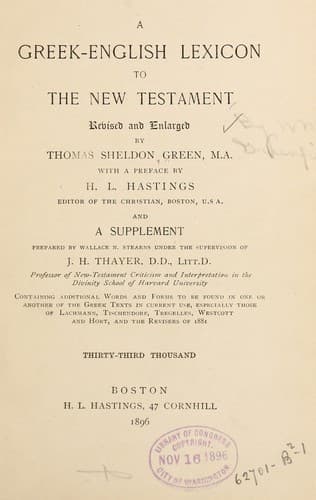
A Greek-English Lexicon to the New TestamentGreenfield, William
Religion
A Greek-English Lexicon to the New Testament
Greenfield, William
Bible. New Testament -- Dictionaries -- English; Greek language, Biblical -- Dictionaries -- English
that which is put over or upon; in N.T., a patch, Mat. 9.16.
Mar. 2.21. Lu. 5.36, bis. L.G.
Ἐπιβοάω, ῶ, (ἐπί & βοάω)
f. ήσω,
to cry out to or against; to vociferate, Ac. 25.24.
Ἐπιβουλή, ῆς, ἡ, (ἐπί & βουλή)
a purpose or design against any one; conspiracy, plot,
Ac. 9.24; 20.3, 19, 23.30.
Ἐπιγαμβρεύω, (ἐπί & γαμβρεύω, to marry)
f. εύσω,
to marry a wife by the law of affinity, Mat. 22.24. S.
Ἐπίγειος, είου, ὁ, ἡ, τόν, -ον, (ἐπί & γῆ)
pr. on the earth, Phi. 2.10; earthly, terrestial, Jno. 3.12.
1 Co. 15.40. 2 Co. 5.1. Phi. 3.19; earthly, low, grovelling,
Ja. 3.15.
Ἐπιγίνομαι, (ἐπί & γίνομαι)
to come on, spring up, as the wind, Ac. 28.13.
Ἐπιγῑνώσκω, (ἐπί & γινώσκω)
f. γνώσομαι, a.1. pass. ἐπεγνώσθην,
pr. to make a thing a subject of observation; hence, to arrive
at knowledge from preliminaries; to attain to a knowledge of,
Mat. 11.27, et al; to ascertain, Lu. 7.37; 23.7, et al.; to
perceive, Mar. 2.8; 5.30, et al.; to discern, detect, Mat. 7.16, 20,
et al.; to recognise, Mar. 6.33. Lu. 24.16, 31. Ac. 3.10, et al.;
to acknowledge, admit, 1 Co. 14.37. 1 Ti. 4.3, et al.;
pass. to have one's character discerned and acknowledged,
2 Co. 6.9; fr. the Heb. to regard with favour and kindness,
1 Co. 16.18:
whence
Ἐπίγνωσις, εως, ἡ,
the coming at the knowledge of a thing, ascertainment, Ro. 3.20;
a distinct perception or impression, acknowledgment, Col. 2.2,
et al.
Ἐπιγρᾰφή, ῆς, ἡ
an inscription; a legend of a coin, Mat. 22.20. Mar. 12.16.
Lu. 20.24; a label of a criminal's name and offence, Mar. 15.26.
Lu. 23.38:
from
Ἐπιγράφω, (ἐπί & γράφω)
f. ψω,
to imprint a mark on; to inscribe, engrave, write on, Mar. 15.26.
Ac. 17.23. Re. 21.12; met. to imprint, impress deeply upon,
He. 8.10; 10.16. (ᾰ).
Ἐπιδείκνῡμι, v. νύω, & mid. ἐπιδείκνῠμαι, (ἐπί & δείκνυμι)
f. δείξω,
to exhibit, Mat. 16.1. Ac. 9.39; to show, Mat. 22.19.
Lu. 17.14; 20.24; 24.40; to point out, Mat. 24.1; to
demonstrate, prove, Ac. 18.28. He. 6.17.
Ἐπιδέχομαι, (ἐπί & δέχομαι)
f. δέξομαι,
to admit; to receive kindly, welcome, entertain, 3 Jno. 10;
met. to admit, approve, assent to, 3 Jn. 9.
Ἐπιδημέω, ῶ, (ἐπί & δῆμος)
f. ήσω,
to dwell among a people; to be at home among one's own people;
and, in N.T., to sojourn as a stranger among another people,
Ac. 2.10; 17.21.
Ἐπιδιατάσσομαι, (ἐπί & διατάσσω)
f. ξομαι,
to enjoin any time additional, superadd an injunction &c.
Gal. 3.15. N.T.
Ἐπιδίδωμι, (ἐπί & δίδωμι)
f. δώσω,
to give in addition; also, to give to, deliver to, give into
one's hands, Mat. 7.9, 10. Lu. 4.17; 24.30, 42, et al.;
intrans., probably a nautical term, to commit a ship to the wind,
let her drive, Ac. 27.15.
Ἐπιδιορθόω, ῶ, (ἐπί & διορθόω)
f. ώσω,
to set further to rights, to carry on an amendment, Tit. 1.5.
Ἐπιδύω, (ἐπί & δύω)
f. δύσω,
of the sun, to set upon, to set during, Ep. 4.26.
Ἐπιείκεια, ας, ἡ,
Public-domain text, read in full here on John Shaqi.
Reviews
Reviews
No reviews yet
Be the first to share your thoughts on this work.
Elsewhere in the archive
Join the Discussion
Join the discussion
Sign in to leave a comment or review.
Sign InorCreate an account