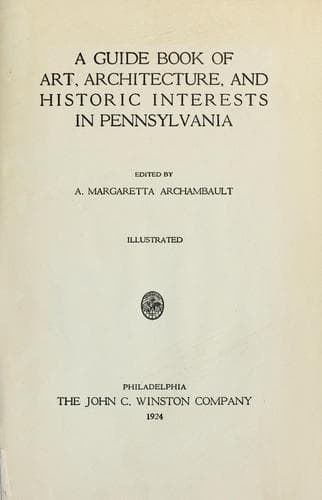
A guide book of art, architecture, and historic interests in Pennsylvania
History
A guide book of art, architecture, and historic interests in Pennsylvania
Architecture -- Pennsylvania; Art -- Pennsylvania; Historic buildings -- Pennsylvania; Pennsylvania -- Guidebooks; Pennsylvania -- History
From Thirty-second and Market Streets, Philadelphia, out Lancaster
Avenue, first turnpike in United States, completed in 1794, pattern for
all subsequent roadbeds; main highway to Pittsburgh, once thronged with
teams, coaches, and Conestoga wagons with six horses, making twenty
miles a day; trip from Philadelphia to Pittsburgh and return, 333 miles,
in six weeks; wayside inns were located a mile apart. Originally part of
Indian trail; later King’s Highway; Lancaster Pike; Main Line; now
Lincoln Highway, made free of tolls July 15, 1917. OVERBROOK, Roman
Catholic Theological Seminary, St. Charles Borromeo, contains painting,
“Crucifixion,” by the late Thomas Eakens. The Pennsylvania Institution
for the Instruction of the Blind, designed by E. A. Allen, Spanish
Renaissance, 1898, architects, Cope & Stewardson, considered finest
residential school for blind in the world, particularly well-equipped
for the purpose. Montgomery County, near NARBERTH station, old Merion
meeting house, built, 1695, stone, sharp roof, curious pointed gables
over doors, peg is still shown where William Penn hung his hat when he
rose to preach; beyond is site of Penn cottage, built, 1695. MERION, Dr.
Barnes’ Art Museum, built of imported French limestone; modern art.
ARDMORE, St. Paul’s Lutheran Church and burial ground, log church,
built, 1769, present church, 1873. Red Lion Inn, still standing.
HAVERFORD, Haverford College for boys, founded in 1833 by Society of
Orthodox Friends, life is focused inward, neither sight nor sound of the
outer world reaches the campus of 225 acres, on which are farm and
woodland, cricket and football fields, tennis courts, a running track
and skating pond; the arrangement of buildings, chiefly modern colonial,
from 1833-1912, shows the result that comes only by slow growth and
care; architects, W. S. Vaux; Cope & Stewardson; W. F. Price; Baily &
Bassett. Library contains over four hundred Babylonian clay tablets,
from 2500 B.C.; Harris collection of Oriental manuscripts; seven hundred
reproductions in fictile ivory, of ancient and medieval carved ivories
in British Museum, from second to eighteenth centuries; Roberts
autographs, more than 11,000 items, covering period from late fifteenth
century to present day; some portraits of Haverford alumni. Old
Haverford meeting house, near Cobb’s Creek, stone, built, 1696, has
horse block used by William Penn in dismounting; chimney had curious
openings in outside wall, through which fire wood was introduced to the
hearth, their position is still traceable. The Buck Tavern, built, 1732,
now Haverford House.
Public-domain text, read in full here on John Shaqi.
Reviews
Reviews
No reviews yet
Be the first to share your thoughts on this work.
Elsewhere in the archive
Join the Discussion
Join the discussion
Sign in to leave a comment or review.
Sign InorCreate an account