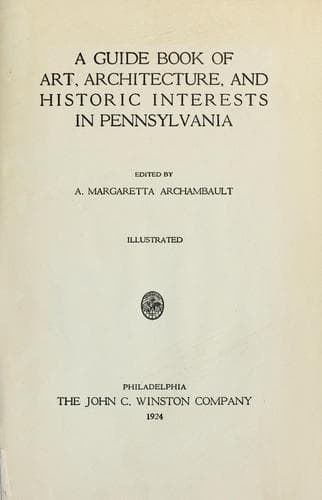
A guide book of art, architecture, and historic interests in Pennsylvania
History
A guide book of art, architecture, and historic interests in Pennsylvania
Architecture -- Pennsylvania; Art -- Pennsylvania; Historic buildings -- Pennsylvania; Pennsylvania -- Guidebooks; Pennsylvania -- History
The principal educational institution is Wyoming Seminary, co-ed, at
KINGSTON, founded in 1844, conducted under auspices of the Wyoming
Conference of the Methodist Episcopal Church, ranks high as a college
preparatory school and has an academic art course. There are many places
of scenic beauty; notably the Conyngham dairy and stock farms at
Hillside, just outside Wyoming Valley, on the road from Kingston to
Harvey’s Lake, which is 1226 feet above sea level; one of the largest
stock farms in the state, covering 651 acres. Sugarloaf Valley, not far
from HAZLETON. The Hazleton Country Club. Glen Summit Springs and the
neighboring country, Bear Creek Village, and Wyoming Valley, viewed
either from Campbell’s Ledge, Mount Lookout, or Prospect Rock.
The principal roads are maintained in good order, and there are no toll
roads in the county. For many years the chief industry has been the
mining of anthracite coal, discovered here in 1762; for a considerable
period it stood first among the counties in annual output; first
development of this coal for shipping to market from the Wyoming region
was in 1776, when two Durham boats purchased cargoes from a mine
operated by R. Greer, near Wyoming. There are many large manufactories.
Within a ten mile circle, having Wilkes-Barre public square as its
center, there were, according to the United States census of 1910,
thirty-three smaller municipalities, cities, boroughs, and hamlets,
having a total population, including Wilkes-Barre, of 266,951. The other
principal towns of this county are Hazleton, population 32,277;
Nanticoke, 22,614; Plymouth, 16,500; Pittston, 18,497; West Pittston,
6968; Kingston, 8952. Peter Frederick Rothermel, prominent historical
painter, was born in Nescopeck, this county, in 1817.
[Illustration: HUNTINGDON COUNTY]
XVIII
HUNTINGDON COUNTY
Formed September 20, 1787; named by Provost William Smith, of the
University of Pennsylvania, in honor of Selina, Countess of Huntingdon,
a benefactress of the University; lies within the central mountainous
region, being drained by the Juniata. Many fine farms are on the rich
soil of the river flats. Juniata iron early became famous, and numerous
iron works were erected; the old Bedford Furnace was near Orbisonia.
Abundance, variety, and value of the ores; rich and convenient deposits
of limestone; contiguity of the Broad Top, Allegheny and Cumberland coal
fields, combine to indicate the importance of this country. Other
industries are coal-mining, lumber, agriculture, and manufactories.
Large water-power dams of the Pennsylvania Central, and Raystown Water
Power Companies generate electric light and power.
Public-domain text, read in full here on John Shaqi.
Reviews
Reviews
No reviews yet
Be the first to share your thoughts on this work.
Elsewhere in the archive
Join the Discussion
Join the discussion
Sign in to leave a comment or review.
Sign InorCreate an account