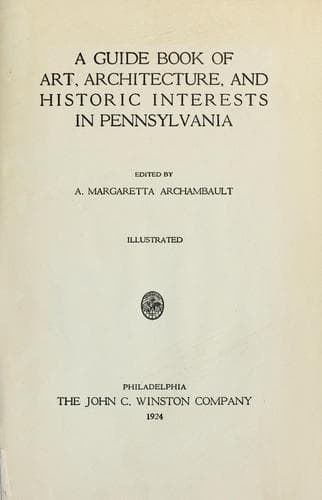
A guide book of art, architecture, and historic interests in Pennsylvania
History
A guide book of art, architecture, and historic interests in Pennsylvania
Architecture -- Pennsylvania; Art -- Pennsylvania; Historic buildings -- Pennsylvania; Pennsylvania -- Guidebooks; Pennsylvania -- History
design; native stone; architects, Hunt & Hunt; in niches are busts of
Washington and Franklin; mortised in alternately are bas-reliefs of F.
A. Michaux, 1746-1802, author of “Flora Boreali Americana”; General
Lafayette in 1777; and Bernard Palissy, 1506-89, potter, and writer on
botany and forestry; sculptor, J. F. Weir. The Homestead Library,
formerly home of Cyrille Pinchot, pure colonial, is in center of town;
to the rear is Normandie Cottage, an architectural gem, replica of a
peasant’s home cottage.
Gray Towers, the Pinchot estate, native stone, reproduction of a
baronial castle in the Scottish Highlands, crowns the hill about 1000
feet above Milford; the old Scotch garden, with high stone wall, is of
rare beauty; Yale School of Forestry is on the Pinchot estate, within
echo of the Sawkill Falls. Monument to Tom Quick, the avenger of the
Delaware, is on his birthplace; he killed ninety-nine Indians to avenge
the death of his father, who was the first settler in Milford, in 1733.
The principal denominations are represented in the churches. Old inns
are, the Crissman House, built, 1810; the Sawkill House, 1823, southern
colonial; the Dimmick House, 1828, Horace Greeley stopped here in 1840
and later; one of his fondest hopes was the coöperative, community of
interest settlement, known as the “Sylvania Society,” which he, with
others, organized in 1842 at Greeley; founded on the “Sacredness of
toil,” but the young men, sons of affluent parents, who had been sent
there by New Yorkers who bought stock, did not know how to work, nor did
they wish to learn, and so they deserted.
The Bluff House on the banks of the Delaware, built, 1876, commands a
fine view; lawn of Milford Inn is planted with rare shrubs and trees
from all parts of the world; the Hermitage has three unique bronze
sundials, sculptor, Louis F. Ragot; the one depicting Father Time with
upraised reaper, is beautiful. The Hermit’s Glen, so a legend goes, is
where an old French hermit of profound knowledge and benevolence found
the water of life after a world-wide search; these waters now flow into
the lake through two bronze masques; two cement giants hold up the dam
that feeds the lake. Wells Glen lies along the Sawkill Brook;
rhododendrons, wood flowers, and giant hemlocks make it beautiful.
Childs Park, back of DINGMAN’S FERRY, given in perpetuity for use of the
public by Mrs. G. W. Childs, is a rugged mountain stretch, woodland and
meadow; cataracts and deep pools are in the trout stream that comes
through it.
Public-domain text, read in full here on John Shaqi.
Reviews
Reviews
No reviews yet
Be the first to share your thoughts on this work.
Elsewhere in the archive
Join the Discussion
Join the discussion
Sign in to leave a comment or review.
Sign InorCreate an account