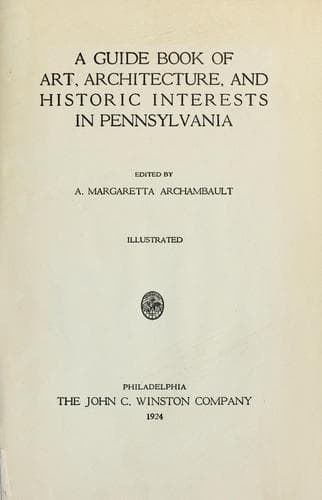
A guide book of art, architecture, and historic interests in Pennsylvania
History
A guide book of art, architecture, and historic interests in Pennsylvania
Architecture -- Pennsylvania; Art -- Pennsylvania; Historic buildings -- Pennsylvania; Pennsylvania -- Guidebooks; Pennsylvania -- History
=Roman Catholic.= The churches of this denomination are all notable for
good architecture, interior sumptuous, ecclesiastical decoration.
CATHEDRAL OF SS. PETER AND PAUL, finely situated on Logan Square and the
Parkway; Classic Renaissance, brownstone; built 1846-64; architect,
Napoleon LeBrun; “The Crucifixion,” back of the high altar, genuine
fresco painting, is by Constantine Brumidi, who, about the same time,
executed important decorations, in the same medium, in the dome of the
Capitol at Washington; on entering the church, in chapels on both sides
of the door, are mural decorations by Henry J. Thouron, said, by high
authority, to be the best mural paintings in the United States; the
first was placed in 1911 as a fitting background for a statue of the
Virgin and Child by Louis Madrazzi, which Mr. Thouron brought from Paris
as a gift to the Cathedral; in the north transept is a painting, “The
Dead Christ,” attributed to Titian; a work of art of exceptional merit
is a large ivory crucifix, the master work of Carlo Pazenti, an
Augustinian lay brother, about 1840; acquired for the church, with much
difficulty, by the venerable John N. Neumann, fourth Bishop of
Philadelphia; when, during the Civil War, the Sanitary Fair was being
held in Logan Square, Archbishop Wood, then Bishop Wood, exhibited this
beautiful work daily, for the benefit of the great cause; it was
returned each evening to its place in the Cathedral. ST. JOHN THE
EVANGELIST, Thirteenth Street above Chestnut, for a short time the
cathedral; early English, Gothic; interior, perpendicular Gothic;
cornerstone laid by Bishop Kenrick, third Bishop of Philadelphia; church
opened April 8, 1832: a flagellation of Christ, much darkened, by
Garacci, was presented to the church by Joseph Bonaparte soon after its
completion: Mozart’s “Requiem Mass” was rendered, for the first time in
America, at St. John’s Church, and the music there today, is said to be
the best church music in Philadelphia. ST. PATRICK’S, Twentieth Street
below Locust, originated in a frame church in 1839, on east side of
Nineteenth Street near Spruce; the seventy-fifth anniversary was
celebrated in 1916, was attended by many notable dignitaries of the
church. Windows by d’Ascenzo. ST. FRANCIS DE SALES, Forty-seventh Street
and Springfield Avenue, Romanesque, with Byzantine details; built,
1907-10; architect, Henry D. Dagit, Philadelphia; the leaded glass is
particularly beautiful; windows are of the antique school and extremely
rich in color, including four rose windows, designed and made by Nicolo
d’Ascenzo, Philadelphia. Four old historic churches rather near
together, ST. JOSEPH’S, on Willing’s Alley, south of Walnut, below
Fourth Street; built on site of first Roman Catholic Church in
Pennsylvania, established by a member of the “Society of Jesus” from
Maryland, in 1731; ST. MARY’S, Fourth Street, above Spruce; ST.
AUGUSTINE’S, Fourth Street, above Race; and HOLY TRINITY, northwest
Public-domain text, read in full here on John Shaqi.
Reviews
Reviews
No reviews yet
Be the first to share your thoughts on this work.
Elsewhere in the archive
Join the Discussion
Join the discussion
Sign in to leave a comment or review.
Sign InorCreate an account