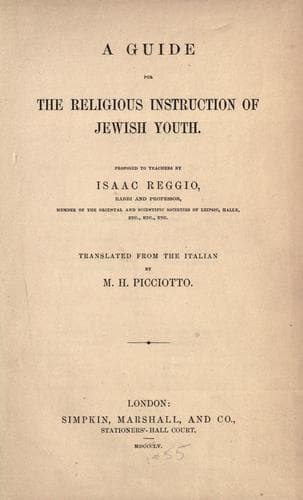
A Guide for the Religious Instruction of Jewish YouthReggio, Isaac Samuel
Religion
A Guide for the Religious Instruction of Jewish Youth
Reggio, Isaac Samuel
Judaism -- Juvenile literature
LXXXVII. But not to strict justice alone our conduct towards our
fellow-men must conform itself; we are bound to act on the principles of
the most generous benevolence and charity. Those acts of a noble mind
and a magnanimous heart, commonly called virtue, which are by moralists
only _recommended_, as meritorious works, are by the Divine law
_enjoined_, as obligatory, in the most absolute sense. Alms, for
instance, are, in the Mosaic law, a duty of the rich, and a right of the
needy. God is the owner of the land; He gave it to the diligent to
cultivate, and through His blessing their labours prosper; He assigned
to the poor His dues on the cultivated soil, and ordered that to them
should be left the total produce of every seventh year, the tithes of
some other years, and the gleanings of the fields and vineyards. It was
not thereby intended to render charity legal and compulsory, depriving
it of its noblest attribute, which is spontaneity, but to show more
conspicuously the importance attached to it, having otherwise left free
all acts of kindness and mercy, to which the law does not fix any
measure. To this class also belong the precepts, which make it a duty to
give timely assistance to him who is about to succumb to fatigue and
labour, to supply with provisions the discharged servant, to restore
before sunset the clothing taken in pawn, to obviate danger in building
a house, to put no obstructions before the blind, to grant every kind of
relief to whomsoever stands in need, without exacting, or even
expecting, any remuneration, to rescue those who are in danger, to
defend the weak, to protect the widow and the orphan, to attend the
sick, and to give sepulture to the dead. These and other similar
prescriptions, which make of charity a duty, carry with them the great
lesson, that justice must go always hand-in-hand with mercy, since the
all-just God is also all-merciful, and he who satisfies not both alike,
does not fully discharge his duties to society.
Public-domain text, read in full here on John Shaqi.
Reviews
Reviews
No reviews yet
Be the first to share your thoughts on this work.
Join the Discussion
Join the discussion
Sign in to leave a comment or review.
Sign InorCreate an account