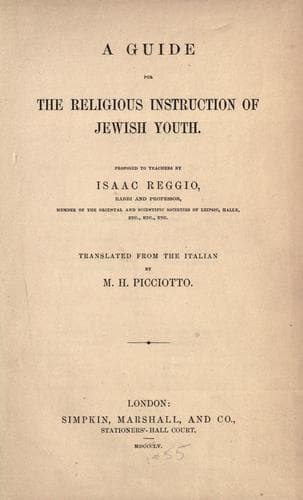
A Guide for the Religious Instruction of Jewish YouthReggio, Isaac Samuel
Religion
A Guide for the Religious Instruction of Jewish Youth
Reggio, Isaac Samuel
Judaism -- Juvenile literature
LXXXVIII. The Mosaic dispensation, which considers the whole world as a
grand unit, and tends to carry out the idea of moral good to its fullest
extent, could not leave unnoticed the relations of man with beings of
different species; therefore it also mentioned duties that we owe to the
irrational creatures and inanimate beings. True, God granted to man a
superiority, a dominion over all things created on earth, permitting him
the use, and even the destruction, of them, whenever this is necessary
to his own welfare, or conducive to his own advantage; but He wisely
restricted such power within certain limits. Mosaism regards the entire
universe as a temple manifesting the glory of God, and directs us to
admire in the single component parts the profound counsels and infinite
wisdom of Him who created and harmonized so many wonders. Thus we are
commanded, in the first place, to respect the laws of nature, as
established by its Supreme Author from the creation, and not to do
capriciously things that are in direct opposition to such laws. From
this principle spring the various prohibitions to couple sexually
different species of animals, to practise on them castration, to
constrain simultaneously to joint labour beasts of unequal strength, to
muzzle them while thrashing, and to use towards them any kind of
cruelty. Nay, it is enjoined that they, also, should participate in the
general rest ordained for men on festivals. It is well for us to reflect
how incomplete are as yet the modern institutions for the prevention of
cruelty to animals, when compared with those of the ancient Mosaic code.
Even the simultaneous sowing of heterogeneous species, and the
ingrafting of plants, are considered as violations of the law of nature,
which had established the distinctions. In the second place, in order
that man, while using all things for his benefit, might not imagine that
he is their absolute master, and should not forget the true Owner, who
conferred them upon him under various reservations, he was enjoined not
to appropriate at the same time two things, one of which had been born
or produced from the other; but in the act of converting to his own use
some object or being, he should spare that which gave it birth, and not
lay his hands upon both simultaneously. He is thus to learn to respect
the causes while enjoying the effects; and from the secondary causes he
will mentally ascend to the primitive one, which produced them all from
nought. This is the sense and intention of the prohibitions of taking in
a covey the mother with the young, of slaughtering a quadruped together
with that which gave it birth, of cutting down a tree, were it even for
the necessity of a siege, while we are enjoying its fruit.
CHAPTER XIV.
Public-domain text, read in full here on John Shaqi.
Reviews
Reviews
No reviews yet
Be the first to share your thoughts on this work.
Join the Discussion
Join the discussion
Sign in to leave a comment or review.
Sign InorCreate an account