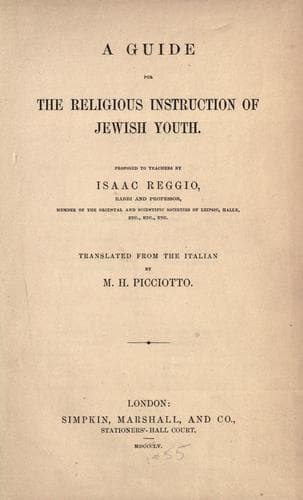
A Guide for the Religious Instruction of Jewish YouthReggio, Isaac Samuel
Religion
A Guide for the Religious Instruction of Jewish Youth
Reggio, Isaac Samuel
Judaism -- Juvenile literature
LXXXIX. THE third class of duties comprises those which man has towards
himself; and here the fundamental rule, from which they all emerge,
sounds thus--"Sanctify thyself, for I, the Eternal, am holy," which, in
other words, may be rendered as follows--"Imitate God, for thou wast
created in His image." As, however, this sanctification of self cannot
possibly be effected without knowing and loving God, and without walking
in his ways by practising justice and charity, it follows that this
third article is the cardinal point, which virtually comprehends in
itself the other two--it _is_ the ultimate object of all the revelation,
which purposed nothing more or less than the perfection of man; to this
grand end the whole scheme of revelation was designed.
It is clear that, in regulating the precepts of sanctification, the
revealed word had not alone to deal with the human soul, but to take
into account the body also, without whose concurrence man cannot attain
perfection. Designed for a receptacle of an immortal spirit, and for an
instrument to carry out the actions of life, the body must be preserved
entire, pure, and inaccessible to all contamination that would be an
obstacle to the high spiritual functions to be accomplished by its
means. To ensure this inaccessibility, as far as possible, the Divine
law prescribed for all mankind a rule, which, though to the short
understanding of many its character may not appear very clear, was
deemed by the eternal wisdom as calculated to promote morality.
Previously to Abraham's vocation, God forbade Noah and his children to
feed upon blood; and the scriptural declaration, that the soul of
animals resides in their blood, seems to indicate that the motive of
that prohibition is to prevent the human body being brutalised by
absorbing within itself, and assimilating, a large amount of an inferior
vitality, and thus causing the material propensities to preponderate in
man. But even if the true reason of that prohibition remained unknown to
us, this would not be the only instance of man being obliged to
acknowledge his own ignorance, and to bow reverently before an explicit
and rigorous commandment of God.
Public-domain text, read in full here on John Shaqi.
Reviews
Reviews
No reviews yet
Be the first to share your thoughts on this work.
Join the Discussion
Join the discussion
Sign in to leave a comment or review.
Sign InorCreate an account