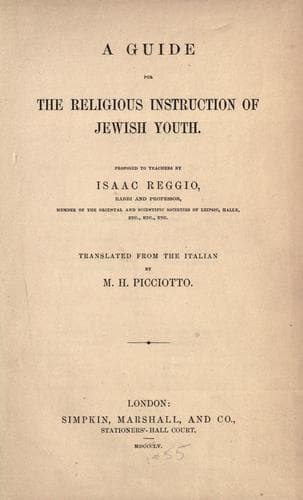
A Guide for the Religious Instruction of Jewish YouthReggio, Isaac Samuel
Religion
A Guide for the Religious Instruction of Jewish Youth
Reggio, Isaac Samuel
Judaism -- Juvenile literature
XCI. Passing to other moral requirements which come within the sphere of
man's duties towards himself, it is unnecessary to demonstrate here how
it is incumbent upon every man to choose a state in society adapted to
his individual faculties and aptitude, to be industrious, sober and
decorous, to fix on a well-regulated distribution of his time and work,
to be economical without parsimony and liberal without prodigality, and
generally to follow such rules of wisdom as tend to render life
prosperous, and human conduct acceptable to society. All such rules are
self-evident, and grow necessarily out of the general principle which
demands of the functions of the body to subserve the attainment of
self-sanctification. But we must now speak precisely of this
sanctification, to point out briefly in what it consists. From the
Divine prescript, "Sanctify yourselves because I am holy," we clearly
conclude that the type of sanctification is to be sought, not in
ourselves, but in God; therefore, to sanctify ourselves is to shape our
own acts and will upon the known will of God; to be fully penetrated
with the idea of Him; to hold steadfastly to Him; to take Him for a
guide in the walks of life; to make Him the goal of our actions and the
centre of our hopes; to devote our solicitude to the accomplishment of
the high designs of His eternal wisdom; to perform whatever is agreeable
to Him; to imitate, as far as possible, His perfections; in short, so to
act, that what in Him is absolute may become in us subjective; and thus
the sanctity of God will produce man's own sanctification. Having
established this sovereign principle, revelation has accomplished its
intentions, has attained its object, for the whole sum of the Divine law
is concentrated in it; and worship, morals, judicial laws, and all
single observances prescribed, are but branches or constituent parts of
this principle; they all flow from, and return to, it, with a systematic
consequence.
Public-domain text, read in full here on John Shaqi.
Reviews
Reviews
No reviews yet
Be the first to share your thoughts on this work.
Elsewhere in the archive
Join the Discussion
Join the discussion
Sign in to leave a comment or review.
Sign InorCreate an account