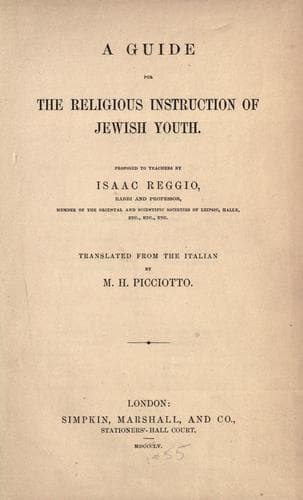
A Guide for the Religious Instruction of Jewish YouthReggio, Isaac Samuel
Religion
A Guide for the Religious Instruction of Jewish Youth
Reggio, Isaac Samuel
Judaism -- Juvenile literature
XCII. Besides the three cardinal articles above stated, the observance
of which, in their general tendencies at least, is incumbent on all
mankind, there are in the sacred code various special prescriptions
obligatory only on Israel, as him who first received the revelation, and
who is bound to preserve it with particular means, and to testify it for
ever, by his acts and by his very existence. Through such prescriptions,
the law designed either to keep alive among the people the idea of the
high mission entrusted to it, and the memory of signal favours which
Providence prodigally conferred upon it in the early times of the
institution, or to initiate it into a more scrupulous sanctitude, by
interdicting to it some things that are left permissive to others. It is
not necessary here to give a complete list of such precepts, as the mere
inspection of the sacred text suffices to point them out; and we shall
confine ourselves to indicating some of the more important. Pre-eminent
among them stands the sabbath, the elevated tendency of which has been
already explained in the Sinaitic revelation; next come the three
Festivals of Passover, Pentecost, and Tabernacles, which, besides being
linked to, and combined with, rural events and circumstances, are also
designed to commemorate luminous epochs in the national history; the
great day of atonement, as a highly important act of reconciliation with
God; the circumcision, as an ineffaceable mark of the adoption of
Israel; the assiduous study of the Divine law, as the purest source of
truth, and repository of the religious idea; the fringes in the
garments, the phylacteries or frontlets, the inscriptions on the
door-posts, and such like commemorative means; the redemption of the
firstborn children; and the offering of the first fruits, as a
demonstration of filial dependance on, and gratitude to, the Supreme
Cause; the prohibition to feed on certain loathsome animals, and
reptiles and insects, in order not to assimilate to the human body
substances of a low, imperfect, and possibly deteriorated organization;
the interdiction of marriages between certain degrees of relationships,
because wanting in the antagonism required in connubial unions;[5] the
duty of offering up prayer, one of the noblest offices of piety, and the
most effectual medium of communion with God; that of confessing sins,
the inevitable consequence of human frailty; the injunctions to reject
idolatry, divinations, charms, exorcisms, sortileges, and all manner of
superstitions, all of which are obstacles to the development of the
religious idea; and several other precepts, which may be found dispersed
throughout the sacred code, all having similar tendencies, and coming
more or less directly within the scope we have assigned to them.
Public-domain text, read in full here on John Shaqi.
Reviews
Reviews
No reviews yet
Be the first to share your thoughts on this work.
Elsewhere in the archive
Join the Discussion
Join the discussion
Sign in to leave a comment or review.
Sign InorCreate an account