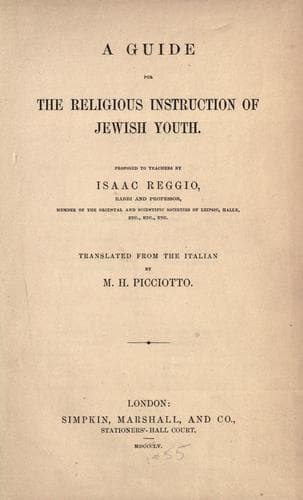
A Guide for the Religious Instruction of Jewish YouthReggio, Isaac Samuel
Religion
A Guide for the Religious Instruction of Jewish Youth
Reggio, Isaac Samuel
Judaism -- Juvenile literature
XCVI. What the inspired Arch-prophet had foretold came too truly to
pass, as soon as the people of Israel, mixing too freely with their
corrupt neighbours, wished to imitate them, and assumed the form of a
monarchy. Ambition and lust of power could ill agree with a law, which
establishes individual liberty and equality of rights. Consequently, it
was not long before Paganism ascended the throne, attended by a hideous
train of profligacies and crimes; and, what then remained of the Mosaic
institutions, consisted only of the material service of the temple, and
some exterior acts mechanically performed, but sadly lacking the idea,
which alone constitutes their merit. To put an end to so great a
disorder, Prophetism rose. With admirable zeal, energy, eloquence, and
abnegation, thundering in the courts, the temple, and the public
markets; now by word of mouth, then by writings; now threatening, anon
exhorting; always struggling with infinite obstacles, and setting at
defiance the tyranny of the ruling powers with the sole prestige of the
animated word, Prophetism undertook to revivify the religious idea,
almost extinguished, or crushed under the weight of universal
perversion. But to repress with greater force the overflowing depravity,
and to combat the evil with an opposite extreme, it was proper to divest
the religious idea of its particularising and national forms, and to
present it in its more comprehensive and general character, in its
celestial beauty of a future reign of happiness, based on love, justice,
liberty, and universal peace. This was precisely what Prophetism did.
Therefore, he would be greatly mistaken, who would suppose, in the
expressions used by the Prophets, any intention of slight towards the
ceremonial laws, and those biblical prescriptions, which are specially
intended for the chosen people. True, these are to be regarded as means
calculated to a superior end; but they remain in full force and validity
until that end (which is in store in the Eternal Mind) shall have been
fully and finally attained. The Prophets eliminated nothing from, and
added nothing to, the law; they sought to revive the religious idea,
which is the foundation and aim of the law; they brought it into
prominence, to impress it more forcibly on the minds of a people who had
nearly lost it. But they did more; they bounded over the confines of the
present, transferred themselves through the imagination to a future
final re-arrangement of the human conditions; and, giving to the
religious idea its greatest possible latitude, depicted a future state
of ideal perfection, which, while it offered a vivid contrast with
contemporary corruption, left to posterity an imperishable monument of
their inspired eloquence and exquisite foresight.[7]
Public-domain text, read in full here on John Shaqi.
Reviews
Reviews
No reviews yet
Be the first to share your thoughts on this work.
Elsewhere in the archive
Join the Discussion
Join the discussion
Sign in to leave a comment or review.
Sign InorCreate an account