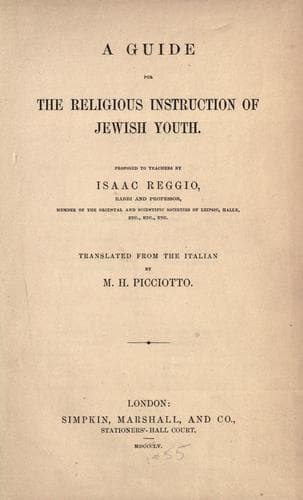
A Guide for the Religious Instruction of Jewish YouthReggio, Isaac Samuel
Religion
A Guide for the Religious Instruction of Jewish Youth
Reggio, Isaac Samuel
Judaism -- Juvenile literature
[Note 7: The original has here several succeeding paragraphs devoted
to a historical review of various phases of Judaism, which it describes
under the names of Talmudism, Rabbinism, Caraism, and Cabalism.
Believing this digression, or appendix, to be unnecessary to the general
purposes of the present book, I have omitted it in the translation,
_with the sanction of the distinguished Author himself._--THE
TRANSLATOR.]
CHAPTER XVI.
XCVII. JUDAISM is now clearly delineated before us. From the outline
that we have endeavoured to sketch, it is evident that the religion of
the Jew imposes upon him solemn duties towards God, towards his
fellow-men, and towards himself. A sincere, pure, undivided, active,
loving worship of his heavenly Father, and a constant practice of
justice, benevolence, and charity, in their widest sense, will lead to
his self-sanctification, which is the aim intended for him. These are
his fundamental duties, as far as regards actions. Many of the
observances prescribed by Holy Writ teach the modes and means of
carrying out such duties. All such prescriptions as are strictly
connected with the existence of the temple, and the sojourn in Palestine
are dispensed with, since the destruction of the former, and the
dispersion of Israel on the face of the earth. But no doubts can exist
as to the others, which are all, and for ever, in full force, having
been ordained for all times and all places.
But the Jew has also a creed to profess. According to the Scriptures, he
is bound to believe in the unity, eternity, omnipotence, omniscience,
unerring justice, and infinite mercy of God; in His general providence
over all the universe, which He created and which He governs, and His
more special providence over man; he is bound to believe in the divine
origin of the Mosaic revelation, in its truth and immutability, and in
its efficacy to promote his own sanctification; he is bound to believe
in the spirituality and immortality of the human soul, in its
destination and aptitude to perform all that is good, and in the future
reward of the virtuous and punishment of the wicked; and, lastly, he is
bound to believe, that, in order to make known, preserve, and propagate
these dogmas, a covenant was established between God and Israel, in
consequence of which the latter is called _servant of God, son of God,
holy people_, and has the particular mission to conform to the will of
God, which is called _walking in the ways of the Eternal_. These various
points are, however, so intimately connected with each other, and form
so complete a system, that one being admitted, the others follow as
legitimate consequences.
Public-domain text, read in full here on John Shaqi.
Reviews
Reviews
No reviews yet
Be the first to share your thoughts on this work.
Elsewhere in the archive
Join the Discussion
Join the discussion
Sign in to leave a comment or review.
Sign InorCreate an account