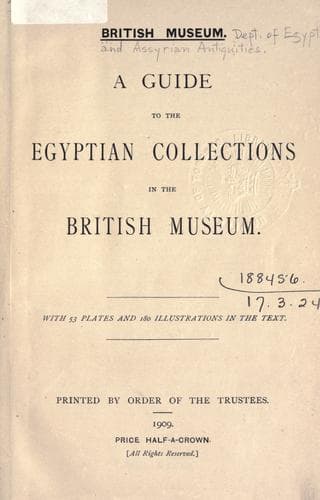
A guide to the Egyptian collections in the British MuseumBritish Museum. Department of Egyptian and Assyrian Antiquities
History
A guide to the Egyptian collections in the British Museum
British Museum. Department of Egyptian and Assyrian Antiquities
Egypt -- Antiquities
Of =personal ornaments= of the dead the variety is endless, but a very
good general idea of them may be obtained from the collections in the
Table-cases in the Fourth Egyptian Room. In =Case F=, one side is filled
with amulets, many of which were worn for decorative purposes during
life by their owners, and the other side contains a collection of
=necklaces= and =beads= belonging to various periods between B.C. 1700
and A.D. 100. The beads are made of gold, amethyst, garnet, carnelian,
mother-of-emerald, lapis-lazuli, agate, topaz, glass, etc., all which
materials were believed to possess magical properties, and the pendants
were intended to bring luck, long life, health, etc., to their wearers.
The necklaces of the early period will be found in =Case J=, some of
which belong to the period of the Early Empire; the porcelain beads and
necklaces are in =Case B=. At one period unpierced, round and conical
beads were made in Egypt. (See Table-case L, Second Egyptian Room.)
They were found placed in semi-circular rows on a layer of clay, which
was intended to serve as a necklace or breastplate for a mummy. A fine
display of =gold rings=, =pendants=, =bracelets=, etc., will be found in
=Table-case J= in the Fourth Egyptian Room. Worthy of special note are:
the gold =bracelets= of =Nemareth= (Nos. 134, 135), the gold uraeus (No.
105), the “heart-scarab” in massive gold setting (No. 132), the hawk of
gold (No. 133), gold pendant (No. 137), gold pectoral (No. 138), =gold
bangle= with figures in gold and silver alternately (No. 140), gold lion
(No. 175), =Scarab of Sebekemsaf=, a king of the XIVth dynasty (No.
195), =gold rings= inscribed with the names of Thothmes III, Ḥātshepset,
Shishak I, Ȧmen-ḥetep III, and Ptolemy III (Nos. 198, 201, 217, 237,
266), =silver rings= inscribed with the names of Ȧmen-ḥetep IV, Shishak,
and Psammetichus (Nos. 390, 392), and a very fine collection of 64
scarabs in agate, onyx, lapis-lazuli, etc., from the tomb of a princess
of the XIIth dynasty, about B.C. 2400 (No. 382).
[Illustration: PLATE XVII.
General view of the Sarcophagus of King Nekht-Ḥeru-ḥebt, B.C. 378,
engraved with scenes and texts from the Book of What is in the Other
World, and selections from the Book of the Praises of Rā.
[Southern Egyptian Gallery, Bay 25, No. 923.]]
[Illustration: PLATE XVIII.
Granite sarcophagus of Nes-Qeṭiu, a prince, chancellor, and scribe of
Ȧmen-Rā.
XXVIth dynasty, or later.
[Southern Egyptian Gallery, Bay 26, No. 825.]]
[Illustration: PLATE XIX.
Sepulchral tablet of Ban-āa, a scribe.
XVIIIth dynasty.
[Northern Egyptian Gallery, Bay 9, No. 474.]]
CHAPTER IX.
NUMBERS CARDINAL AND ORDINAL. DIVISIONS OF TIME: THE CALENDAR, SOTHIC
PERIOD. CHRONOLOGY.
Public-domain text, read in full here on John Shaqi.
Reviews
Reviews
No reviews yet
Be the first to share your thoughts on this work.
Elsewhere in the archive
Join the Discussion
Join the discussion
Sign in to leave a comment or review.
Sign InorCreate an account