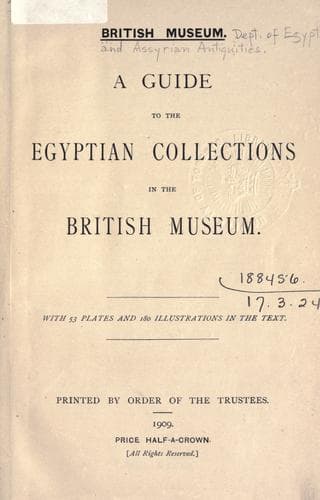
A guide to the Egyptian collections in the British MuseumBritish Museum. Department of Egyptian and Assyrian Antiquities
History
A guide to the Egyptian collections in the British Museum
British Museum. Department of Egyptian and Assyrian Antiquities
Egypt -- Antiquities
Of these systems the one proposed by the late Dr. H. Brugsch (No. 5)
agrees best with the general evidence of the monuments as to the length
of the period of Dynastic civilization; it is therefore used, with some
modification of the dates of the XVIIIth dynasty, in this book. It has
been declared that the intervals which he placed between the VIth and the
XIIth, and the XIIth and the XVIIIth dynasties are too long, but, on the
other hand, many objections can be urged against the reductions recently
suggested. It is proposed to reduce the date given by Brugsch for Menes,
B.C. 4400, to B.C. 3315; but there is no evidence in support of the
reduction. The view has been steadily growing for years that some of
the dates proposed by Brugsch for the kings of the XVIIIth dynasty must
be reduced, and as this view is supported by the evidence derived from
the recently published Babylonian Chronicles, and the general testimony
of recently excavated monuments, the dates of the reigns of the early
kings of that dynasty may well be brought down nearly one hundred years.
The other evidence on the point, being of an astronomical character,
can only be dealt with by experts. Egyptian chronology is a difficult
subject, chiefly because of an insufficiency of facts about the reigns
of the kings of the VIIth-XIth, and the XIIIth-XVIIth dynasties. Every
year, however, witnesses the removal of a certain number of difficulties,
and as long as excavations are made in Egypt a steady increase in the
knowledge of the subject may reasonably be hoped for.
CHAPTER X.
THE HISTORY OF EGYPT.
Palaeolithic Period.
The only remains of this Period in the British Museum are =flint axes=,
borers, scrapers, etc., typical examples of which are exhibited in
Table-case M in the Third Egyptian Room.
Neolithic Period.
Towards the end of this Period Egypt was divided into =two kingdoms=,
of the South and of the North; of the kings of the latter a few names
are known from the Palermo Stele, _e.g._, =Seka=, =Khaȧu=, =Tȧu=, =Thesh
Neheb=, =Uatch-nār= or =Uatch-ȧnt=, =Mekha=, etc. No date can be assigned
to the rule of these kings, but they probably all reigned before B.C.
4500. Whilst Egypt was divided into two kingdoms the country was invaded,
probably more than once, by a people who made their way thither from the
East, or South-East, and settled as conquerors in the Nile Valley and
Delta. They brought with them a civilization superior to the African, and
appear to have introduced wheat, barley, the sheep, the art of writing,
a superior kind of brickmaking, etc. After a time, length unknown, there
arose a king who succeeded in uniting the Kingdoms of the North and South
under his sway; that king was =Menȧ= or =Menes=.
DYNASTIC PERIOD—ANCIENT EMPIRE.
First Dynasty. From the city of This.
_About_ B.C. 4400.
Public-domain text, read in full here on John Shaqi.
Reviews
Reviews
No reviews yet
Be the first to share your thoughts on this work.
Elsewhere in the archive
Join the Discussion
Join the discussion
Sign in to leave a comment or review.
Sign InorCreate an account