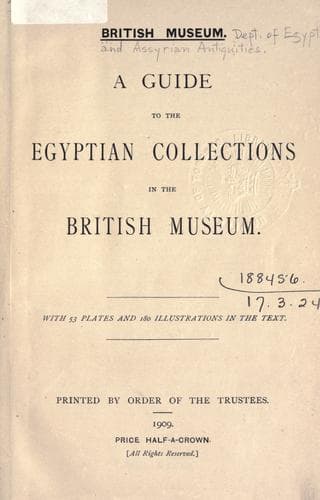
A guide to the Egyptian collections in the British MuseumBritish Museum. Department of Egyptian and Assyrian Antiquities
History
A guide to the Egyptian collections in the British Museum
British Museum. Department of Egyptian and Assyrian Antiquities
Egypt -- Antiquities
Another Hyksos king, =Āa-qenen-Rā Ȧpepȧ II=, is made known to us by
Sallier Papyrus II (No. 10,185), which shows that he was a contemporary
of one of the Theban kings called =Seqenen-Rā=. According to this
document there was enmity between Ȧpepȧ II and Seqenen-Rā, his vassal,
but as the papyrus is mutilated the result of their enmity is unknown.
During one portion of the Hyksos Period a group of petty kings, or
chiefs, each of whom was called =Ȧntef-āa=, ruled either at Thebes or
Coptos, and a few of their monuments have come down to us. In the British
Museum are: =1.= Stone memorial =pyramid of Ȧntef-āa Ȧp-Maāt= (Vestibule,
South wall, No. =341=); =2.= Slab sculptured with a figure of =Ȧntef
Nub-kheper-Rā= (Bay 4, No. =342=); =3.= Gilded =coffin of Ȧntef-āa=
(Wall-case 2, First Egyptian Room).
It has been said above that there was enmity between Ȧpepȧ II and
Seqenen-Rā, but the monuments prove that there were three kings who
bore the =Seqenen-Rā= prenomen, and it seems that all three waged war
against the Hyksos in the north; their full names were =Seqenen-Rā=
(=I=), =Tau-āa=, =Seqenen-Rā= (=II=), =Tau-āa-āa=, =Seqenen-Rā= (=III=),
=Tau-āa-qen=. The greatest warrior of the three was undoubtedly the
last named, and it was he who determined to throw off the yoke of the
foreigner. He was supported by all classes of Egyptians, for the Hyksos
were hated, and especially by the priests of Ȧmen-Rā at Thebes, who
regarded the demand of the Hyksos king that Seqenen-Rā III should worship
the god Sutekh as a grave insult to their god Ȧmen-Rā. Seqenen-Rā III
refused to worship Sutekh, and proclaimed his independence. Of the
battles which were fought during the war that followed nothing is known,
but it is clear that in one of them the brave leader in the struggle for
national independence was slain. When his mummy was unrolled at Cairo,
in 1886, it was seen that the lower jaw-bone was broken and the skull
split; there were also large wounds in the side of the head and over the
eye, and one ear had been hacked away. Tau-āa-qen was succeeded by his
son (?) =Ka-mes=, whose reign was, however, short. To him belonged the
fine =bronze axe-head= inscribed with his names and titles exhibited in
Table-case B in the Third Egyptian Room (No. 5), and the =spear head=,
similarly inscribed, of which see a cast in the same case (No. 191).
Ka-mes had several children by his wife Ȧāḥ-ḥetep, and some of their sons
may have ruled for a short time; but the country was very unsettled, and
the first to succeed in restoring law and order was =Ȧāḥmes=, or =Amāsis
I=, the founder of the XVIIIth dynasty.
CHAPTER XII.
THE NEW EMPIRE.
The Eighteenth Dynasty. From Thebes.
_About_ B.C. 1600.
Public-domain text, read in full here on John Shaqi.
Reviews
Reviews
No reviews yet
Be the first to share your thoughts on this work.
Elsewhere in the archive
Join the Discussion
Join the discussion
Sign in to leave a comment or review.
Sign InorCreate an account