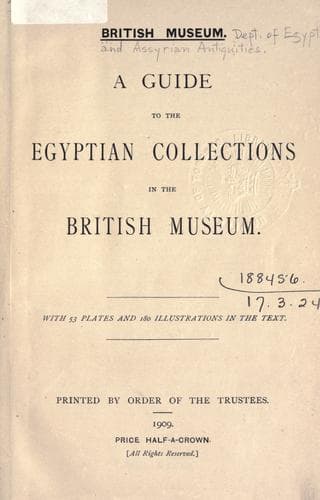
A guide to the Egyptian collections in the British MuseumBritish Museum. Department of Egyptian and Assyrian Antiquities
History
A guide to the Egyptian collections in the British Museum
British Museum. Department of Egyptian and Assyrian Antiquities
Egypt -- Antiquities
=Ȧmen-ḥetep I=, the son of Amāsis I, continued the war in Nubia, and
the rebuilding of the temple of Ȧmen and other sanctuaries; he was
the founder of the great brotherhood of the =Priests of Ȧmen=. From
a building made by him at Dêr al-Baḥarî came the magnificent painted
limestone =statue of the king=, in the mummied form and with the White
Crown of Osiris, exhibited in the Northern Egyptian Gallery (No.
=346=), and the stele on which are sculptured figures of =Neb-Ḥapt-Rā
Menthu-ḥetep= and =Ȧmen-ḥetep I= (Bay 9, No. =347=). Other interesting
monuments of this reign are: the stele of =Pa-sheṭ=, a judge, who is seen
adoring the king and queen (Bay 7, No. =348=); and a stele with figures
of the king and queen (Bay 9, No. =349=). The inscriptions and scenes on
several stelae show that Ȧmen-ḥetep I and his queens were included among
the gods; see the stelae of =Ḥui= (Bay 8, No. =352=), =Pa-ren-nefer= (Bay
8, No. =353=), =Ȧmen-em-Ȧpt= (Bay 10, No. =354=), =Ȧmen-men= (Bay 10, No.
=355=), and =Ḥui=, son of Nefert-ithȧ (Bay 11, No. =357=).
[Sidenote: B.C. 1550.]
=Teḥuti-mes I=, or =Thothmes I=, the son of Ȧmen-ḥetep I, made Napata,
at the foot of the Fourth Cataract, the border of his kingdom to the
south; and he waged war in Northern Syria. He added to the temple of
Ȧmen, and set up obelisks at Karnak. Among objects bearing his name are
two =bricks= and a =steatite vase= inscribed with his prenomen and name
(Wall-cases 150 and 175 in the Fourth Egyptian Room).
=Thothmes II=, the son of Thothmes I and Mut-Nefert, married his
half-sister Ḥātshepset; during his short reign, war was carried on in
Syria and Nubia, and many temples in Egypt and forts in Nubia were
repaired or rebuilt. Among the monuments of this reign may be mentioned
the =scarabs= in Table-case D (Fourth Egyptian Room) and a portion of a
slab inscribed with his Horus name (Third Egyptian Room, Wall-case 103,
No. 937).
After the death of Thothmes II, his widow =Ḥātshepset= reigned alone
for some years, and she built the famous =temple of Dêr al-Baḥarî=, the
walls of which she decorated with reliefs illustrating her =Expedition
to Punt=. The temple was called “Tcheser-Tcheseru,” _i.e._, “Holy of
Holies,” and the architect was Senmut; it was built close to the temple
of Menthu-ḥetep Neb-ḥap-Rā, and was ranged in three terraces. It was
enclosed by a wall, and was approached by an avenue of sphinxes, which
led to the pylon at the entrance, where stood two obelisks. She also set
up two great granite obelisks in honour of her father Thothmes I. About
twenty years before her death she associated her nephew Thothmes III
with her in the rule of the kingdom. Many =scarabs=, a gold =ring=, a
wooden =cartouche=, and an alabaster =vase=, inscribed with her names and
titles, are exhibited in the Fourth Egyptian Room (Table-cases P and J
and Wall-case 139).
Public-domain text, read in full here on John Shaqi.
Reviews
Reviews
No reviews yet
Be the first to share your thoughts on this work.
Elsewhere in the archive
Join the Discussion
Join the discussion
Sign in to leave a comment or review.
Sign InorCreate an account