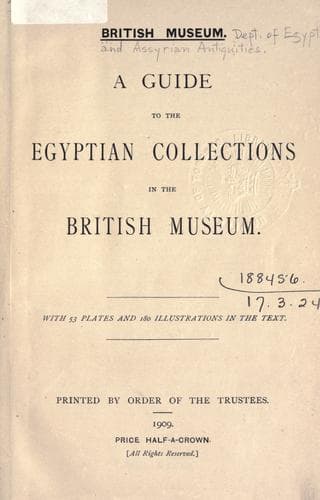
A guide to the Egyptian collections in the British MuseumBritish Museum. Department of Egyptian and Assyrian Antiquities
History
A guide to the Egyptian collections in the British Museum
British Museum. Department of Egyptian and Assyrian Antiquities
Egypt -- Antiquities
Mer-en-Ptaḥ, or =Menephthah=, was associated with his father in the rule
of the kingdom for about twelve years before he became sole king. In the
fifth year of his reign Egypt was attacked by a confederation of tribes
from Libya, and by certain peoples from the northern shores and islands
of the Mediterranean. Menephthah fortified his towns and collected an
army, and in the fierce battle which followed he was victorious. The
Libyan king barely escaped with his life; but six of his brothers and
sons and over 6,000 of his soldiers were slain, and 9,000 were taken
prisoners. It is probable that the =Exodus= took place during the early
years of this reign. In the year of his victory he caused a Hymn of
Triumph to be cut upon the back of a stele of Ȧmen-ḥetep III at Thebes,
and among the peoples of Palestine whom he conquered are mentioned
the =Israelites=, 𓇌𓊃𓏭𓂋𓇋𓄿𓂋𓏤𓌙𓀀𓁐𓏪. His mummy was found in the tomb of
Ȧmen-ḥetep II at Thebes, and is now in Cairo. Like his father he caused
his names to be cut on monuments which he had not made, _e.g._, the lion
of Ȧmenemḥāt III (No. 173), the pillar of Ȧmen-ḥetep III (No. 419), and a
statue (No. 577) and pillar of his father (No. 599). Among the monuments
of his reign may be mentioned the =door-jamb= from his temple at Memphis
(No. =1169=). The remaining kings of the XIXth dynasty were:—
=1.= =Seti II Mer-en-Ptaḥ.= See his =statue= holding a shrine with a head
of Ȧmen (Bay 21, No. =616=), a slab from his tomb at Thebes (Central
Saloon, No. =617=), and a =plaque= and a =scarab= in the Third and Fourth
Egyptian Rooms (Wall-case 124 and Table-case D). The D’Orbiney Papyrus in
the British Museum containing the =Tale of the Two Brothers= was written
during the reign of this king. =2.= =Ȧmen-mes=, of whose reign nothing is
known. =3.= =Sa-Ptaḥ=, of whom many reliefs are found at various places
in Egypt. On his death a period of anarchy followed, and nothing like
order prevailed in the country until =Set-nekht=, a relative of Rameses
II, obtained supreme power.
Public-domain text, read in full here on John Shaqi.
Reviews
Reviews
No reviews yet
Be the first to share your thoughts on this work.
Elsewhere in the archive
Join the Discussion
Join the discussion
Sign in to leave a comment or review.
Sign InorCreate an account