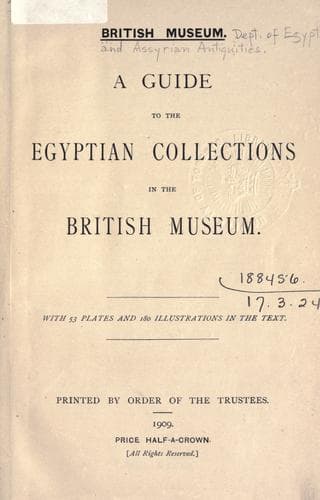
A guide to the Egyptian collections in the British MuseumBritish Museum. Department of Egyptian and Assyrian Antiquities
History
A guide to the Egyptian collections in the British Museum
British Museum. Department of Egyptian and Assyrian Antiquities
Egypt -- Antiquities
Teôs was succeeded by his son =Nekht-neb-f=, or =Nectanebus II=, in
whose reign the Persians, under =Artaxerxes III=, once again obtained
possession of the country. The reign of Nectanebus II, who was the =last
native king= of Egypt, was on the whole peaceful and prosperous; he
repaired many temples, and his name is found on buildings in all the
great sanctuaries from Philae to Sebennytus in the Delta. The statues and
stelae of the period are well-cut, and the work is tasteful and delicate.
Among them may be mentioned: A granite =statue= of Nectanebus II (Bay 29,
No. =924=); the two =intercolumnar slabs= on which are representations of
the king kneeling and making an offering (Bay 27, No. =926=; Bay 28, No.
=927=); and a small =gilded door= from the model of a shrine, on which
the king is represented kneeling and making an offering (Table-case C,
Fourth Egyptian Room).
The Persians, having succeeded in obtaining the supreme power once again,
held it for a period of about eight years; but their rule was hateful to
the Egyptians, and when =Alexander the Great= (born B.C. 356, died 324),
who had defeated Darius III at the Battle of Issus, =B.C. 332=, arrived
at Memphis, he was welcomed as the saviour of the country. He marched to
the Oasis of Sîwah (Jupiter Ammon) and entered the temple of Ȧmen-Rā, and
worshipped the god, who acknowledged him to be his son and therefore the
rightful king of Egypt. Soon after, in B.C. 331, Alexander founded the
city of Alexandria.
In the scramble for the provinces of Alexander’s great Empire which took
place at his death, Egypt fell to the share of one of his generals,
Ptolemy Lagus, who administered the country in the name of Alexander’s
sons, =Philip Arrhidaeus= and =Alexander II= of Egypt, the former of
whom never set foot in the country; the latter was brought thither as
a child of six years, and was murdered when he was thirteen years old
(B.C. 311); but in spite of these facts Ptolemy Lagus caused buildings
to be erected in their names, and ruled the country as their loyal
servant. To the period B.C. 332-306 belong the portion of a =clepsydra=
inscribed with the name of =Alexander the Great= (Bay 29, No. =948=); the
portion of a =clepsydra= inscribed with the name of =Philip Arrhidaeus=
(Bay 29, No. =949=); and the =papyrus of Nes-Ȧmsu=, containing the Book
of Overthrowing Āpep, which is dated in the twelfth year of “Pharaoh
Alexander, the son of Alexander,” _i.e._, Alexander II (No. =10,188=).
In the seventh year of his reign Alexander II restored to the temples of
the city of Pe-Ṭep (Buto) the property which had been wrested from it by
Xerxes the Great: a cast of the stele which commemorates this fact will
be found in Bay 28, No. =950=.
CHAPTER XIII.
THE PTOLEMAÏC PERIOD.
Public-domain text, read in full here on John Shaqi.
Reviews
Reviews
No reviews yet
Be the first to share your thoughts on this work.
Elsewhere in the archive
Join the Discussion
Join the discussion
Sign in to leave a comment or review.
Sign InorCreate an account