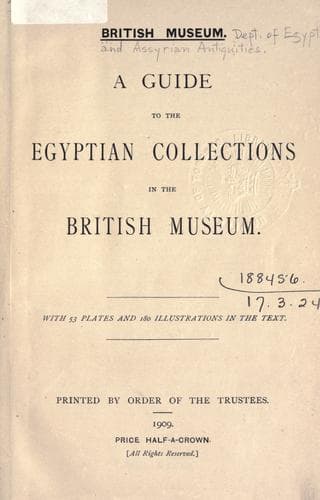
A guide to the Egyptian collections in the British MuseumBritish Museum. Department of Egyptian and Assyrian Antiquities
History
A guide to the Egyptian collections in the British Museum
British Museum. Department of Egyptian and Assyrian Antiquities
Egypt -- Antiquities
=Ptolemy V, Epiphanes, B.C. 205=, was a great benefactor of the temples
of Egypt; and to mark their gratitude to him the priests of all Egypt
met in solemn assembly at Memphis in the ninth year of his reign, and
passed a Decree ordering that increased honours be paid to the king and
his ancestors, that a statue of him be set up in each of the temples, and
that a copy of the Decree, inscribed upon a stone stele, in hieroglyphic,
demotic and Greek writing, be likewise set up in each temple of the
first, second, and third class throughout Egypt. This Decree was duly
carried out, for portions of three or four stelae, inscribed with the
text of it, have been discovered. Most important of all is the stele
which was found by M. Boussard in 1798, which, because it was dug up
near Rosetta, is commonly known as the =Rosetta Stone= (see No. =960=,
Southern Egyptian Gallery). A special interest attaches to this monument,
for from it =Thomas Young=, in 1816-1818, deduced the values of several
letters of the Egyptian alphabet, and succeeded in reading the name of
=Ptolemy=. Next with the help of this text and of an obelisk from Philae,
the Frenchman =Champollion= read the name Cleopatra, and formulated a
correct system of Egyptian decipherment. (For details see page 41 ff.)
During the reign of Ptolemy V, the Egyptians invoked the protection of
Rome.
[Illustration: Head of a statue of one of the Ptolemies, about B.C. 300.
[Southern Egyptian Gallery, Bay 27, No. 947.]]
=Ptolemy VI, Eupator=, died the year he became king. During the reign of
=Ptolemy VII, Philometor= (B.C. 173), the Jews were permitted to build
a temple at Onion, Onias being high-priest. (For a stele on which are
sculptured figures of Ptolemy VII and the two Queens Cleopatra, see Bay
27, No. =961=.) =Ptolemy VIII= was murdered. =Ptolemy IX, Euergetes II,
B.C. 147-117=, finished the temple of Edfû, and repaired many temples
both in Egypt and Nubia. From one of these came the fine monolithic
=granite shrine= (see =Plate L=) in which a sacred bird or animal was
kept (Bay 30, No. =962=). It was found lying on its side among the ruins
of a Coptic church on the Island of Philae; it had been utilized by the
builders of the church as the base of a Christian altar. =Ptolemy X,
B.C. 117=, conferred great benefits on the temples of the First Cataract
(see Bay 29, No. =963=); =Ptolemy XI= and =Ptolemy XII= were killed in
B.C. 87 and 81 respectively; =Ptolemy XIII, B.C. 80-51=, began to build
the =temples of Denderah and Esna=; =Ptolemy XIV, B.C. 51=, and his
sister =Cleopatra= were left by their father, Ptolemy XIII, under the
guardianship of the Roman Senate, and =Pompey= was made their guardian.
After the battle of Pharsalia, Pompey fled to Egypt, and was murdered at
the instance of Ptolemy XIV, who had banished his wife Cleopatra. In B.C.
48, Julius Caesar landed in Egypt, defeated Ptolemy, who was drowned, and
reinstated Cleopatra. =Ptolemy XV= was appointed co-regent; but he was
Public-domain text, read in full here on John Shaqi.
Reviews
Reviews
No reviews yet
Be the first to share your thoughts on this work.
Elsewhere in the archive
Join the Discussion
Join the discussion
Sign in to leave a comment or review.
Sign InorCreate an account