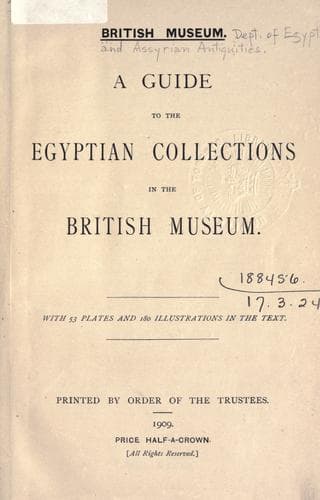
A guide to the Egyptian collections in the British MuseumBritish Museum. Department of Egyptian and Assyrian Antiquities
History
A guide to the Egyptian collections in the British Museum
British Museum. Department of Egyptian and Assyrian Antiquities
Egypt -- Antiquities
Among the noteworthy monuments of this period are: A statue of the
goddess Isis, holding before her a figure of Osiris, whom she
protects with her wings, dedicated to the goddess by one =Shashanq=
(Bay 28, No. =964=); massive green =granite beetle=, symbol of
Kheperȧ, the self-produced god, the creator of the universe, and the
type of resurrection (Central Saloon, No. =965=); stone =serpent=,
with the bust of a woman (Bay 32, No. =966=); green =basalt coffin=
of the lady =Ānkhet= (Bay 29, No. =967=) and the =limestone coffin=
of =Ḥes-Peṭān-Ȧst= (Bay 26, No. =968=); limestone =window= from the
clerestory of the temple of Denderah (Bay 25, No. =972=); and a marble
=sun-dial= from Alexandria (Bay 29, No. =976=). An interesting group
of stelae, with demotic inscriptions, is exhibited in Bay 27 (Nos.
=983-990=); and in Bay 29 (No. =994=) is the stele of =Euonymos=, with an
inscription in Greek and demotic. Among the stelae which give the ages
of deceased persons may be noted those of =Ḥer-ȧbu=, a priest of king
Saḥu-Rā (?), who lived fifty years, seven months, and five days (Bay 30,
No. =995=); =Tashermut=, a priestess who died aged ninety-seven years
(Bay 27, No. =996=); and =Berenice= (?) who died aged sixty-four years,
eight months, and twenty-six days (Bay 29, No. =998=).
Of all the stelae of this period the most interesting is that of the
lady =That-I-em-ḥetep=, who belonged to a family that reckoned among
its members several princes of Memphis and high priests of Ptaḥ (Bay
29, No. =1027=). She was born in the ninth year of the reign of Ptolemy
XIII, about B.C. 71, and when fourteen years old she was married to her
half-brother, the priest =P-shere-en-Ptaḥ= (see his stele in Bay 27, No.
=1026=). During the first twelve years of her married life she gave birth
to three daughters, but no son, which caused her husband great grief.
She and her husband prayed to the god I-em-ḥetep, the son of Ptaḥ, for a
son, and the god, appearing to P-shere-en-Ptaḥ in a dream, promised to
grant his prayer if he carried out certain works in connexion with the
temple. When the priest awoke he caused the works to be taken in hand,
and soon after they were completed his wife gave birth to a son who was
named I-em-ḥetep, and surnamed Peṭā-Bast (see his stele in Bay 27, No.
=1030=). Four years afterwards That-I-em-ḥetep died, and was buried with
due ceremony by her husband, whom she addresses thus: “O my brother, my
husband, my friend, the Ur-kherp-ḥem (_i.e._, high priest of Memphis),
cease not to drink, to eat, to be drunken, and to marry wives, and to
enjoy thyself, and to follow the desire of thy heart by day and by night;
and let not sorrow or sadness find a place in thy heart during all the
years which thou shalt live upon earth. Ȧmenti (_i.e._, the land of the
dead) is the land of stupor and darkness, and a place of oppression for
those who are therein. The august ones sleep in their mummied forms; they
Public-domain text, read in full here on John Shaqi.
Reviews
Reviews
No reviews yet
Be the first to share your thoughts on this work.
Elsewhere in the archive
Join the Discussion
Join the discussion
Sign in to leave a comment or review.
Sign InorCreate an account