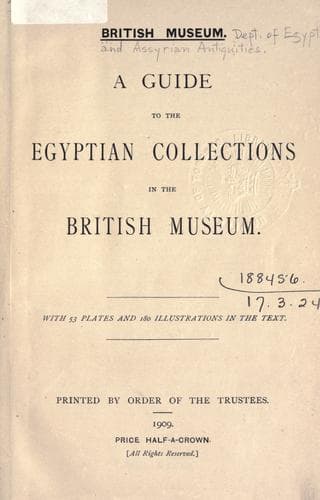
A guide to the Egyptian collections in the British MuseumBritish Museum. Department of Egyptian and Assyrian Antiquities
History
A guide to the Egyptian collections in the British Museum
British Museum. Department of Egyptian and Assyrian Antiquities
Egypt -- Antiquities
In the =Book of Gates=, a somewhat similar work, the road from earth to
heaven is marked by a series of Gates through which the deceased hoped
to pass. The texts, which are fully illustrated, describe the progress
of the Boat of the Sun-god to the Kingdom of Osiris, the Judgment in the
Hall of Osiris, the life of the beatified in the Elysian Fields, and the
punishment of the wicked and of the foes of the Sun-god by dismemberment
and burning. Following these comes a set of magical texts and pictures
which describe and illustrate the ceremonies which were performed daily
to make the sun to rise. They show that the Egyptians used to make a
model of the sun, and place it in a boat, and then bring to it arrows
to represent rays, and disks to represent the hours; fire was next
kindled with the fire-stick and applied to the model, and appropriate
formulas having been recited, the body of the sun was believed to be
reconstituted.
[Illustration: PLATE II.
Scenes and texts from the Sixth Section of the Book of What is in the
Other World. From the sarcophagus of King Nekht-Ḥeru-ḥebt, B.C. 378.
[Southern Egyptian Gallery, Bay 25, No. 923.]]
=10.= As an example of Rituals may be mentioned the famous =Daily Ritual
of the Divine Cult=, the texts of which were inscribed upon papyrus and
cut on the walls of temples, _e.g._, Abydos. From this we learn that the
king was supposed to perform daily a series of elaborate ceremonies in
connection with the statue of Ȧmen, and to present to it unguents, wine,
incense, articles of sacred apparel, etc. By means of these he entered
into communion with the god, who bestowed upon him his vital power,
strength, and spiritual qualities.
=11.= =Hymnology= is well represented by the hymns to the gods Rā,
Rā-Harmachis, Temu and Osiris, which are found in the great Papyrus of
Ani in the British Museum (No. 10,470), and by the fine =Hymn to the
Nile=, of which two copies are preserved in the British Museum (Sallier
II, No. 10,182, and Anastasi VII, No. 10,222). Of somewhat different
character, though equally interesting, are the Hymns to Ȧmen contained in
the Anastasi Papyrus II (No. 10,243). Under this head may be grouped the
=Litany of Osiris= in the Papyrus of Ani, and the =Addresses of Horus= to
his father Osiris in the Papyrus of Nebseni (No. 9900).
Public-domain text, read in full here on John Shaqi.
Reviews
Reviews
No reviews yet
Be the first to share your thoughts on this work.
Join the Discussion
Join the discussion
Sign in to leave a comment or review.
Sign InorCreate an account