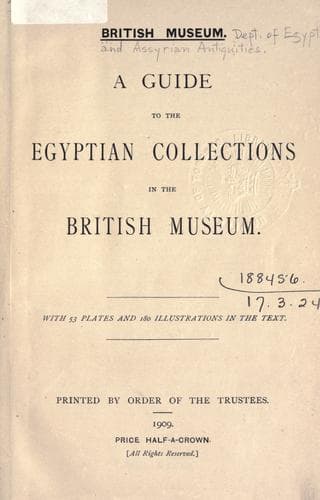
A guide to the Egyptian collections in the British MuseumBritish Museum. Department of Egyptian and Assyrian Antiquities
History
A guide to the Egyptian collections in the British Museum
British Museum. Department of Egyptian and Assyrian Antiquities
Egypt -- Antiquities
=12.= =Service books= are represented by the =Book of Overthrowing
Āpepi=, a work which contains a series of spells and incantations that
were recited in the great temple of Ȧmen-Rā at Karnak (Thebes) on certain
days of the month. These were directed against Āpepi, the great foe of
the Sun-god, and enemy of all goodness and truth, who took the form of a
monster serpent, and waged war against all the gods daily. The rubrics
contained directions for ceremonies, in which wax-figures were burned
in the temple fires, whilst the priests recited the spells in the Book.
There is a complete copy of the work in the British Museum (No. 10,188),
which also contains a list of the accursed names of Āpepi, and the text
of the hymn of praise which was sung when the arch-fiend was overthrown.
=13.= =Exegesis= is represented by two valuable copies of a work which
forms the XVIIth Chapter of the Book of the Dead in the Papyrus of
Ani (No. 10,470), and the Papyrus of Nebseni (No. 9900). In it a text
treating of the origin of the gods and their relation to Rā, and of the
doctrine of the union of Rā and Osiris, etc., is dissected, and each
sentence of the work is followed by a statement of the opinions of the
various great religious Colleges of Egypt.
=14.= An example of a rare class of work is found cut on a black stone
slab in the Southern Egyptian Gallery (No. 797). The text states that it
was copied from an inscribed board which had become worm-eaten in the
reign of Shabaka, king of Egypt, about B.C. 700. From what is legible
on the slab we are justified in assuming that the work contained a sort
of philosophical statement of the religious beliefs of a priest who was
trying to systematize certain of the old traditions of the country, and
to evolve a system of belief which should be consonant with the special
traditions current at Memphis at that time concerning the god Ptaḥ.
=15.= Another most important section of religious literature consists of
the funerary inscriptions cut on =sepulchral tablets=, or grave-stones,
which form so large a portion of the Egyptian collections of the British
Museum. In the vestibule and galleries is exhibited a splendid series
of such monuments, the oldest dating from the IVth dynasty, about B.C.
3800, and the most recent from the first century A.D.; thus the series
represents a period of about four thousand years. The value of these
monuments is very great, for they not only give the various forms of the
prayer to the gods for sepulchral offerings in the different periods
of Egyptian history, but they afford a great deal of information about
the attributes of the gods, and they illustrate the growth and decay of
many forms of belief, details of ritual, etc. On =Plates III-VIII= are
reproduced good typical examples of sepulchral tablets of the IVth, XIth,
XIIth, XVIIIth, XIXth, and XXXth dynasties.
Public-domain text, read in full here on John Shaqi.
Reviews
Reviews
No reviews yet
Be the first to share your thoughts on this work.
Join the Discussion
Join the discussion
Sign in to leave a comment or review.
Sign InorCreate an account