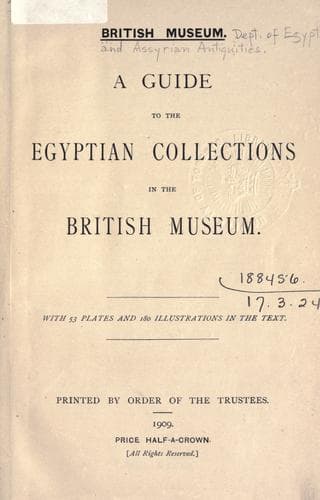
A guide to the Egyptian collections in the British MuseumBritish Museum. Department of Egyptian and Assyrian Antiquities
History
A guide to the Egyptian collections in the British Museum
British Museum. Department of Egyptian and Assyrian Antiquities
Egypt -- Antiquities
A work of a somewhat similar character is the very interesting set of
“=Instructions=” given by a high official to his son Pepi, which we know
from the Second Sallier Papyrus and the Seventh Anastasi Papyrus in
the British Museum (Nos. 10,182, 10,222). The writer entreats his son
to adopt the profession of letters, which he points out leads to rich
emoluments, ease, comfort, and dignity, and he begs him to “love letters
as thy mother.” He then compares the toil and unpleasantness of the life
of the blacksmith, carpenter, stone-cutter, barber, waterman, fisherman,
farm-labourer, gardener, fish-seller, sandal-maker, laundryman, etc., and
urges him to devote himself to his books. This work is commonly known as
the =Hymn in Praise of Learning=; it was very popular in schools under
the XIXth and following dynasties, and portions of it, written on slices
of limestone, were set as “copies” for school-boys.
The Egyptians greatly loved works of =Fiction= and =Travel=, and the
copies of such which have come down to us show that they were full
of marvellous incidents, and that they greatly resembled some of the
sections of the “Arabian Nights” of a later period. The =Tale of the
Two Brothers=, in the British Museum (No. 10,183), is one of the best
examples of Egyptian Fiction. In the first part of the story we have a
faithful description of the life of the peasant farmer in Egypt. Ȧnpu,
the elder brother, lives with his wife on a small farm, and Batau, his
younger brother, acts as his companion, steward, and servant. The wife
of Ȧnpu conceived great affection for Batau. One day, when he returned
to the farm on an errand, she told him of her love; Batau rejected her
overtures, left the house, and went about his ordinary work in the
fields. When Ȧnpu returned to his house in the evening, he found the
rooms in darkness, and, going inside, he discovered his wife lying sick
upon the floor and in a state which suggested she had been ill-treated
and beaten. In answer to his questions she told him that Batau had
attacked her and beaten her, and that she was sure when he next came
back to the farm he would kill her; she did not tell him that she had
made herself sick by eating rancid grease, and Ȧnpu did not suspect her
untruth. Ȧnpu then took a large grass-cutting knife and went out to kill
his brother when he arrived. As Batau came to the byre to lead his cattle
into their stalls, the oxen told him that his brother was waiting behind
the door to kill him; looking under the door he saw Ȧnpu’s feet, and
then, setting his load on the ground, he fled from the barn as fast as
he could, pursued by his brother. Whilst they were running, the Sun-god
Shu looked on, and, seeing that Ȧnpu was gaining on Batau, caused a
river full of crocodiles to spring up between them, so that Ȧnpu was on
one bank and Batau was on the other. When Batau had explained the truth
of the matter to Ȧnpu, he departed to the Valley of the Acacia, and the
Public-domain text, read in full here on John Shaqi.
Reviews
Reviews
No reviews yet
Be the first to share your thoughts on this work.
Join the Discussion
Join the discussion
Sign in to leave a comment or review.
Sign InorCreate an account