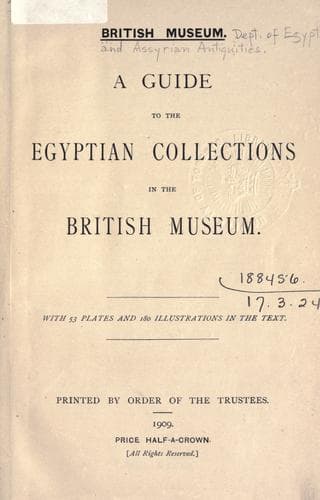
A guide to the Egyptian collections in the British MuseumBritish Museum. Department of Egyptian and Assyrian Antiquities
History
A guide to the Egyptian collections in the British Museum
British Museum. Department of Egyptian and Assyrian Antiquities
Egypt -- Antiquities
elder brother went home, murdered his wife, and threw her body to the
dogs.
The second part of the story is not so easy to follow. Batau went to
the Acacia Valley, and placed his heart on the top of the flower of a
tree, and passed some years in hunting the wild animals of the desert.
Whilst there the gods made for him a wife, who was, however, subsequently
carried off to be the queen of Egypt. By her orders the tree on which was
the heart of Batau was cut down, and the heart fell to the ground, where,
after some time, it was found by Ȧnpu, who went in search of it. Batau
having recovered his life, took the form of a bull, and, after a series
of marvellous transformations, became the father of a king of Egypt. The
papyrus containing this story was written by the scribe Anna, and it was
one of the rolls in the library of Seti II Menephthah.
The =Story of the Doomed Prince= is another good example of Egyptian
Fiction, though the unique copy in the British Museum (Harris, No. 500)
is incomplete at the end. In the story of the =Possessed Princess of
Bekhten= we have a short but interesting account of the driving out of
a violent devil from the body of one of the sisters-in-law of the king
of Egypt, by means of a statue of the god Khensu. The stele containing
the text is in Paris. =Travel= is well represented by the =Adventures
of Sa-Nehat= (papyrus at Berlin); the =Story of a Shipwrecked Sailor=,
who was cast up on an enchanted island, and conversed with a serpent of
fabulous length (papyrus at St. Petersburg); the =Journey of Unu-Ȧmen=,
who went to Bêrût to buy cedar wood for the Boat of Ȧmen-Rā at Thebes,
but was robbed on his way there, and shipwrecked on his way back,
being cast up on the Island of Cyprus (papyrus at St. Petersburg);
and the =Travels of an Egyptian=, in a papyrus in the British Museum
(No. 10,247). In the last work we have an account of the journey of an
official who travelled in Syria and Palestine, and of the misfortunes
which overtook him. He was robbed, his servants ran away, the pole of his
chariot was smashed, and he suffered from heat by day, cold by night, and
want of food and drink. For stealing fruit from a garden near the road he
was haled before the local magistrate and fined heavily.
Public-domain text, read in full here on John Shaqi.
Reviews
Reviews
No reviews yet
Be the first to share your thoughts on this work.
Elsewhere in the archive
Join the Discussion
Join the discussion
Sign in to leave a comment or review.
Sign InorCreate an account