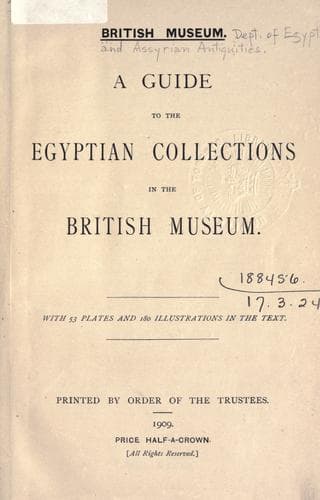
A guide to the Egyptian collections in the British MuseumBritish Museum. Department of Egyptian and Assyrian Antiquities
History
A guide to the Egyptian collections in the British Museum
British Museum. Department of Egyptian and Assyrian Antiquities
Egypt -- Antiquities
up water from the river, the peasant villager had little to amuse him,
except games played with counters and draughts, and the converse of his
companions in the “beer-house.”
[Illustration: Egyptian house, with inner chamber and two flights of
steps leading to the roof.
About B.C. 4000.
[No. 292, Wall-case 107, Third Egyptian Room.]]
=Dwelling Houses.=—The king usually lived in a palace or large building
within the precincts of some temple, or at a very little distance from
one. His palace was probably like the large houses of modern times in
Egypt, _i.e._, it had a courtyard with trees in the middle of it, and a
large garden round about it. In the garden were fish-ponds and groves of
fruit trees, palms, acacias, flowering shrubs with scented blossoms,
and a limited number of flowers. There were arbours, too, covered with
creepers and vines, and the gardeners watered the ground daily by means
of small channels into which water was poured from the _shâdûf_, or the
water wheel. The courtyards were paved, or tiled, or covered with floors
made of inlaid painted porcelain work. The walls and ceilings of the
rooms were painted with rich and intricate designs, and in a few of the
rooms there were openings near the roof which served as windows. The
royal furniture was probably richly painted and inlaid with ebony, ivory,
porcelain, and, under the New Empire, metal vases of all shapes and sizes
would be seen everywhere in the dwelling rooms. Certain large rooms were
set apart for receptions and entertainments, and these probably contained
large raised benches placed along the walls for the guests. The kitchen,
pantry, stables, and general servants’ quarters were outside the house,
but the personal attendants on the king and queen, the steward, the
master of the chambers, etc., had their apartments in the palace. The
storeys were rarely more than two in number, and the roof, which was
flat, was approached by a flight of steps, either from the courtyard or
from the roof of the storey on the ground floor.
Public-domain text, read in full here on John Shaqi.
Reviews
Reviews
No reviews yet
Be the first to share your thoughts on this work.
Elsewhere in the archive
Join the Discussion
Join the discussion
Sign in to leave a comment or review.
Sign InorCreate an account