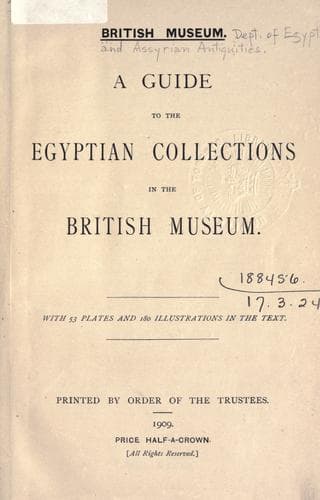
A guide to the Egyptian collections in the British MuseumBritish Museum. Department of Egyptian and Assyrian Antiquities
History
A guide to the Egyptian collections in the British Museum
British Museum. Department of Egyptian and Assyrian Antiquities
Egypt -- Antiquities
The stores of clothing, etc., were kept in a very small room provided
with a stout wooden door with a =bolt-lock= and =key= of simple pattern.
(For examples of bolts and keys, see Wall-cases Nos. 180, 181, in the
Fourth Egyptian Room.) The mistress of the house usually possessed a
small strong =box= in which she kept jewellery, ornaments, and amulets,
and perhaps also her toilet requisites; in some cases the latter were
kept in a special =toilet box=, which held =eye-paint= (stibium, or
antimony, koḥl), =comb=, =hair-tweezers=, =pumice-stone=, =unguents= and
=pomades=, both scented and plain. (See Standard-case L in the Fourth
Egyptian Room.) =Kitchen utensils= were comparatively few in number.
Fresh and sour milk (or curds), soft cheese, sheep-fat, etc., were kept
in earthenware pots, some of which were undoubtedly glazed; bowls made
of earthenware or gourds were common, as were large open saucers. The
=cooking pots= were usually of earthenware, or, among well-to-do people,
of metal. =Knives= made of flint, stone, or metal, were common, and rough
flesh =forks=; in the later period =spoons= were used. =Plates=, in the
modern sense of the word, were unknown; the thick bread-cake served as
a plate for those who squatted round the bowl of cooked vegetables with
pieces of meat on the top, and the thin flat cake was frequently used
as a napkin. A stone =corn-grinder= and a =kneading-stone= were found
in every house. The stock of grain for the family was kept in large
earthenware jars, or in a kind of bin made of mud. Every house contained
a =figure of the god= under whose protection the family lived, and to
this adoration was offered at regular intervals; it took part in the
family-councils, its lot was bound up with that of the family, and it
prevented wandering spirits of evil disposition from entering the house.
There being no =chimney= to the house, the =fire= was lit wherever it was
most convenient, and the smoke went out through the roof and the aperture
in the wall which served as a window. The =fuel= was animal dung, and
such refuse from the straw as could not be eaten by the cow or goat of
the house, and, occasionally, pieces of wood. As =matches= were unknown,
care was taken to keep a small amount of fuel smouldering under the
ashes, so that whenever it was necessary to boil lentils, etc., the fire
could be revived; if the fire was out, recourse was had to the striking
of =flints=, or to some neighbour, or to the temple fire. In primitive
times the Egyptians seem to have used a =fire-stick=, like some of the
tribes of Central Africa.
Public-domain text, read in full here on John Shaqi.
Reviews
Reviews
No reviews yet
Be the first to share your thoughts on this work.
Elsewhere in the archive
Join the Discussion
Join the discussion
Sign in to leave a comment or review.
Sign InorCreate an account