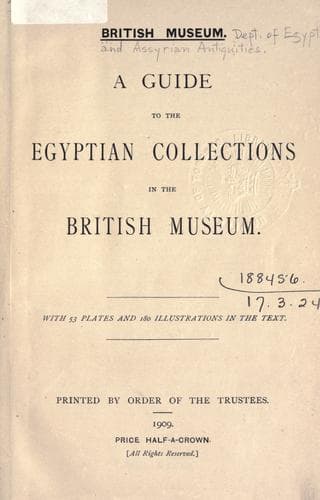
A guide to the Egyptian collections in the British MuseumBritish Museum. Department of Egyptian and Assyrian Antiquities
History
A guide to the Egyptian collections in the British Museum
British Museum. Department of Egyptian and Assyrian Antiquities
Egypt -- Antiquities
The =baker= and =confectioner= found constant employment in every town
and village in Egypt, for the Egyptians loved cakes made with honey,
and fruit of all kinds, and bread and buns made into fanciful shapes.
A great business was done in bread and pastry which were intended to
serve as funerary offerings. Specimens of the bread and the stands on
which the flat loaves were placed, will be found in Table-case H, Third
Egyptian Room. The terra-cotta =cones= 𓏙 which are exhibited in large
numbers in Wall-cases 110, 111, are supposed by some to represent the
loaves, of a pyramidal shape, seen in the hands of kings and others who
are represented offering to the gods. The =barber= also found constant
employment, for many had their whole heads and bodies shaved every
two or three days. He also dressed the hair of ladies on ceremonial
occasions, and made =wigs= (see the fine example in Wall-case H, Third
Egyptian Room). The barber often united to his trade the profession of
=physician=, just as was the case in Europe in the Middle Ages. The craft
of the =boat-builder= was very important in a country where a river was
the chief highway. Flat-bottomed boats and punts used in fishing in the
canals, or fowling on the marshes, were made of bundles of reeds, or
papyrus, tied together, like the modern _tôf_ in the Sûdân. Boats for
carrying merchandize on the river were made of planks of wood pegged
together, which were sometimes kept in position by being nailed on to
ribs, and others were merely tied round with ropes made of papyrus. One
of the earliest known pictures of an Egyptian boat is seen on vase No.
160, in Wall-case No. 5, on the landing of the North-West Staircase.
Models of funeral boats, and barges and war boats are exhibited on the
upper shelf of Wall-cases Nos. 99-110, in the Third Egyptian Room. The
Egyptians were skilful boat builders, and they made rafts capable of
carrying enormous blocks of stone, _e.g._, the obelisks which Queen
Ḥātshepset set up at Karnak. They had equivalents of the modern broad
ferry-boat, barge, lighter, etc., which they worked with oars or “sweeps”
and sails, or towed, when going upstream, and when there was no wind.
CHAPTER V.
ARCHITECTURE, PAINTING, SCULPTURE, ETC.
Public-domain text, read in full here on John Shaqi.
Reviews
Reviews
No reviews yet
Be the first to share your thoughts on this work.
Elsewhere in the archive
Join the Discussion
Join the discussion
Sign in to leave a comment or review.
Sign InorCreate an account