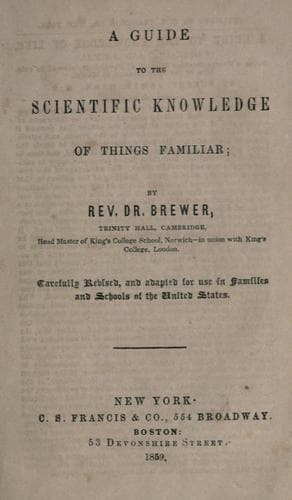
A Guide to the Scientific Knowledge of Things FamiliarBrewer, Ebenezer Cobham
Science
A Guide to the Scientific Knowledge of Things Familiar
Brewer, Ebenezer Cobham
Science -- Juvenile literature
A. As the cor'nea _is too flat_, the image of any near object is formed
_behind the RET'INA of the eye_, and is not seen at all.
[Illustration: The reflection is made at DE, instead of at ABC (the
retina).]
Q. _What sort of GLASSES do OLD people WEAR?_
A. As their cor'nea is _not sufficiently convex_, they must use _double
convex glasses_, to enable them to see objects near at hand.
Q. _What sort of glasses are DOUBLE CONVEX SPECTACLE-GLASSES?_
A. Glasses which _curve outwards_ on both sides.
[Illustration: The figure A is double convex, or convex on both sides.]
Q. _What is the USE of DOUBLE CONVEX spectacle-glasses?_
A. As the image of near objects is reflected _behind the RET'INA_, these
double convex glasses _shorten the focus of the eye_, and bring the
image _into the eye_ (upon the ret'ina).
Q. _Why do NEAR-SIGHTED persons bring objects CLOSE to the eye, in order
to SEE THEM?_
A. As the distance between the _front and back of their eye is too
great_, distant objects are reflected _before they reach the ret'ina_;
therefore, near-sighted persons bring the objects _closer_, in order
that the reflection _may be cast further back_, (to reach the ret'ina).
Q. _Why do OLD people HOLD objects FURTHER OFF, in order to see them
better?_
A. As the distance between the _front and back of their eye is not great
enough_, the reflection of near objects is thrown _beyond the ret'ina_;
therefore, they hold objects _a long way off_, in order to bring their
images _forward_ (so as to cast it on the ret'ina).
Q. _Why are HAWKS able to see such an IMMENSE way off?_
A. Because they have a muscle in the eye which enables them to _flatten
their cor'nea_, by drawing back the crystalline lens.
This muscle is called the "marsupium."
Q. _Why can HAWKS not only see such a long way off, but also objects
within half-an-inch of their eye?_
A. Because their eyes are furnished with a broad circular rim which
_confines the action of this muscle_, and throws the _cor'nea forward_.
Q. _Into how many PARTS may a RAY of LIGHT be DIVIDED?_
A. Into three parts: BLUE, YELLOW, and RED.
N.B. These 3 colours, by combination, make seven. 1.--RED. 2.--Red and
yellow form ORANGE. 3.--YELLOW. 4.--Yellow and blue make GREEN.
5.--BLUE. 6 and 7.--Shades of blue called INDIGO and VIOLET.
Q. _How is it KNOWN, that a ray of light consists of several different
colours?_
A. Because, if a ray of light be cast upon a triangular piece of glass
(called a prism), it will be distinctly divided into seven colours:
1.--Red; 2.--Orange; 3.--Yellow; 4.--Green; 5.--Blue; 6.--Indigo; and
7.--Violet.
Q. _Why does a PRISM DIVIDE a ray of light into VARIOUS COLOURS?_
A. Because all these colours have _different refractive powers_. Red is
refracted _least_, and blue the _most_; therefore, the _blue_ colour of
the ray will be bent to the _top_ of the prism, and the _red_ will
remain at the _bottom_.
Public-domain text, read in full here on John Shaqi.
Reviews
Reviews
No reviews yet
Be the first to share your thoughts on this work.
Elsewhere in the archive
Join the Discussion
Join the discussion
Sign in to leave a comment or review.
Sign InorCreate an account