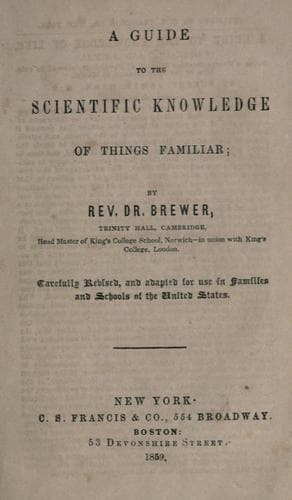
A Guide to the Scientific Knowledge of Things FamiliarBrewer, Ebenezer Cobham
Science
A Guide to the Scientific Knowledge of Things Familiar
Brewer, Ebenezer Cobham
Science -- Juvenile literature
A. Because the _surface_ of things is so _differently constructed_, both
physically and chemically; and, therefore, _some_ things reflect _one_
ray; some _two rays_; some _all_ the rays; and some _none_.
Q. _What mainly determines the COLOUR of any object?_
A. The fluid or gas either _in_ the body, or on its _surface_.
N. B. Nitrogen gives green,--Oxygen gives red,--Hydrogen gives blue
colours.
Q. _Why does DYING a silk, &c. CHANGE its COLOUR?_
A. Because the materials used in dyeing _alter the chemical
construction_ of the substance dyed.
Q. _Why is a ROSE RED?_
A. Because the surface of a rose _absorbs the blue and yellow_ rays of
light, and _reflects_ only the _red_ ones.
Q. _Why does a rose absorb the yellow and blue rays, and reflect the
RED?_
A. Because the action of the sun's rays on the oxygen (accumulated in
the petals) produces an _acid_ which turns them _red_.
The leaves which compose a flower, are called PETALS.
Q. _Why is a VIOLET BLUE?_
A. Because the surface of the violet _absorbs the red and yellow_ rays
of the sun, and _reflects_ the _blue_ only.
Q. _Why do violets absorb the red and yellow rays, and reflect the
BLUE?_
A. Because the petals of the violet contain an _alkali_, which gives
them a _purple tinge_.
Q. _Why is a PRIMROSE YELLOW?_
A. Because the surface of the primrose _absorbs the blue and red_ rays
of solar light, and _reflects_ the _yellow_ ones.
All plants which have much alkali in their ash, have blue or yellow
flowers.
Those which have acid in their ash, have orange, pink, or red flowers.
N. B. Anti-acids (like soda) are called ALKALIS.
Q. _Why are some things BLACK?_
A. Because they _absorb all the rays of light_, and reflect _none_.
Q. _Why are some things WHITE?_
A. Because they _absorb none of the rays of light_, but reflect them
_all_.
Q. _Why are COALS BLACK?_
A. Because they _absorb all the rays of the sun_ which impinge upon
them, and stifle their reflection.
Q. _Why is SNOW WHITE?_
A. Snow consists of a vast number of crystals (or small prisms), which
separate the rays into their elemental colours; but as these crystals
are very numerous, the colours _unite again_ before they meet the eye,
and _appear white_.
N. B. The combination of _all_ colours makes WHITE.
Q. _Why is SUGAR WHITE?_
A. Sugar consists of a vast number of small crystals, which separate the
rays into their elemental colours; but as these crystals are very
numerous, the colours _unite again_ before they meet the eye, and appear
_white_.
Q. _Why is SALT WHITE?_
A. Salt consists of a vast number of small crystals, which reflect the
various rays of light from different points of the salt; and as these
colours _unite_ before they meet the eye, the salt appears to be
_white_.
N. B. The combination of _all_ colours makes WHITE.
Q. _Why are the LEAVES of plants GREEN?_
Public-domain text, read in full here on John Shaqi.
Reviews
Reviews
No reviews yet
Be the first to share your thoughts on this work.
Elsewhere in the archive
Join the Discussion
Join the discussion
Sign in to leave a comment or review.
Sign InorCreate an account