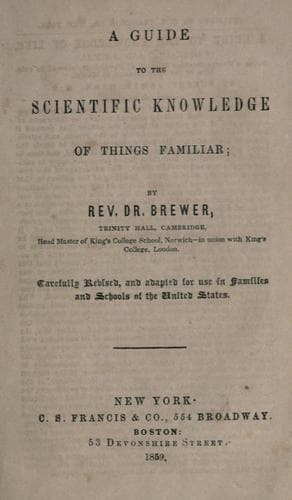
A Guide to the Scientific Knowledge of Things FamiliarBrewer, Ebenezer Cobham
Science
A Guide to the Scientific Knowledge of Things Familiar
Brewer, Ebenezer Cobham
Science -- Juvenile literature
A. Whenever a sound-wave strikes against any _obstacle_ (such as a wall
or hill), _it is reflected_ (or thrown back); and this _reflected sound_
is called an ECHO.
The same laws govern echo as light. (_See p. 370._)
Q. _What places are most FAMOUS for ECHOES?_
A. Caverns, grottoes, and ruined abbeys; the areas of antique halls; the
windings of long passages; the aisles of cathedral churches; mountains,
and ice-bergs.
Q. _Why are caverns, grottoes, and ruined abbeys FAMOUS for ECHOES?_
A. 1st--Because the sound-waves cannot pass _beyond_ the cavern or
grotto, and _must flow back_:
2ndly--The _return waves_ (being entangled by the cavern) are _detained_
for a short time, and come _deliberately_ to the ear.
Q. _Why are antique halls, winding passages, and cathedral aisles FAMOUS
for ECHOES?_
A. Because the sound-waves _cannot flow freely forward_, but strike
against the winding walls perpetually, and are beaten _back_.
Q. _Why are MOUNTAINS and ice-bergs FAMOUS for ECHOES?_
A. Because they present a _barrier_ to the sound-waves _which they
cannot pass_; and are sufficiently elastic to _throw them back_.
Q. _Why do not the walls of a ROOM or church produce ECHO?_
A. Because sound travels with such _velocity_, that the echo is _blended
with the original sound_, and produce but _one impression_ on the ear.
Sound travels 13 miles in a minute.
Q. _Why do very LARGE buildings (as cathedrals), often REVERBERATE the
voice of the speaker?_
A. Because the walls are _so far off from the speaker_, that the echo
does not _get back in time_ to blend with the original sound; and,
therefore, _each_ is heard separately.
Q. _Why do SOME echoes repeat only ONE syllable?_
A. The _further_ the echoing body is _distant_, the _more sound_ it will
_reflect_. If, therefore, the echoing body be _near_, it will repeat but
one syllable.
Q. _Why does an ECHO sometimes repeat TWO or more syllables?_
A. Because the echoing body is _far off_; and, therefore, there is time
for one reflection _to pass away_ before _another_ reaches the ear.
Q. _Why do WINDOWS RATTLE when CARTS pass by a house?_
A. 1st--Glass is _sonorous_; and the air communicates its vibrations to
the glass, which echoes the same sound: and
2ndly--The _window-frame is shaken_ by the sound-waves _impinging
against the window_, and contributes to the noise.
CHAPTER XXIX.
MISCELLANEOUS.
Q. _Why do the BUBBLES in a CUP OF TEA range round the SIDES of the
CUP?_
A. Because the cup _attracts them_.
Q. _Why do all the LITTLE BUBBLES tend towards the LARGE ones?_
A. Because the large bubbles (being the superior masses) _attract them_.
Q. _Why do the BUBBLES of a CUP OF TEA FOLLOW a TEA-SPOON?_
A. Because the tea-spoon _attracts them_.
Q. _Why are the SIDES of a pond covered with LEAVES, while the MIDDLE of
the pond is quite CLEAR?_
A. Because the shore _attracts_ the leaves to itself.
Q. _Why do all fruits, &c. (when severed from the tree) FALL to the
EARTH?_
Public-domain text, read in full here on John Shaqi.
Reviews
Reviews
No reviews yet
Be the first to share your thoughts on this work.
Elsewhere in the archive
Join the Discussion
Join the discussion
Sign in to leave a comment or review.
Sign InorCreate an account