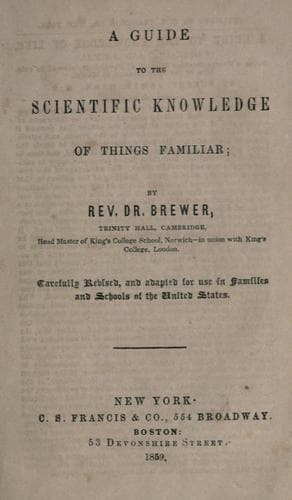
A Guide to the Scientific Knowledge of Things FamiliarBrewer, Ebenezer Cobham
Science
A Guide to the Scientific Knowledge of Things Familiar
Brewer, Ebenezer Cobham
Science -- Juvenile literature
Q. _Whence does the HEAT of our own BODY arise?_
A. The _carbon of the blood_ combines with the _oxygen of the air
inhaled_, and produces _carbonic acid gas_; which produces heat in a way
similar to burning fuel.
Q. _Whence does the HEAT of a DUNGHILL arise?_
A. The _straw, &c. of the dunghill_ undergoes _fermentation_ as it
decays: the fermentation produces _carbonic acid gas_, and heat is
evolved by a species of combustion (as in the two former cases).
Q. _What changes do VEGETABLES undergo from PUTREFACTION?_
A. The _hydrogen of the vegetables_ combines with the _oxygen of the
air_, and forms _water_: again, the _carbon of the vegetables_ combines
with _oxygen of the air_, and forms _carbonic acid gas_. Putrefaction,
therefore, is only another species of combustion.
Q. _What changes do ANIMAL bodies undergo from PUTREFACTION?_
A. The same as vegetables, with this addition--they give out _ammonia_,
_sulphur_, and _phosphorus_ also; which causes the _offensive smell_ of
putrefying animal bodies.
Q. _Why is LIME heated by a KILN?_
A. All marl and chalk abound _in carbonic acid_; and (when heated by a
fire) the carbonic acid _flies off in gas_, producing great heat.
Q. _What is MORTAR?_
A. Lime mixed with sand and water.
Q. _What is LIME?_
A. _Lime-stone burnt_ produces lime.
Q. _Why is the lime-stone BURNT, in order to make it into LIME?_
A. The fire _expels the carbonic acid_, and converts the hard lime-stone
into a _loose powder_.
Q. _Why does MORTAR become HARD, after a few days?_
A. Because the lime _re-imbibes_ the carbonic acid of the air, which was
_expelled by fire_; and the loose _powder_ again becomes as hard as the
original _lime-stone_.
Q. _Why is MORTAR adhesive?_
A. When the carbonic acid is expelled, the hard lime-stone is _converted
into a loose powder_, which (being mixed with sand and water) becomes a
_soft and sticky plaster_; but, as soon as it is placed between bricks,
it _imbibes carbonic acid again_, and hardens into _lime-stone_.
CHAPTER XX.
CARBURETTED HYDROGEN GAS.
Q. _What is CHOKE-DAMP?_
A. _Carbonic acid gas_ accumulated at the bottom of wells and pits. It
is called CHOKE damp, because it _chokes_ (or suffocates) _every animal
that inhales it_. (_see p._ 264).
Q. _What is marsh-gas or FIRE-DAMP?_
A. _Carburetted hydrogen gas_ accumulated on marshes, in stagnant
waters, and coal pits; it is frequently called "inflammable air."
Q. _What is CARBURETTED HYDROGEN GAS?_
A. _Carbon_ combined with _hydrogen_.
Q. _How may CARBURETTED HYDROGEN GAS be PROCURED on marshes?_
A. By _stirring the mud_ at the bottom of any stagnant pool, and
collecting the gas (as it escapes upwards) in an inverted glass vessel.
Q. _What is COAL GAS?_
A. _Carburetted hydrogen_ extracted from coals, by the heat of _fire_.
Q. _Why is carburetted hydrogen gas called FIRE-DAMP, or inflammable
air?_
A. Because it very readily _catches fire and explodes_, when a light is
introduced to it.
Public-domain text, read in full here on John Shaqi.
Reviews
Reviews
No reviews yet
Be the first to share your thoughts on this work.
Elsewhere in the archive
Join the Discussion
Join the discussion
Sign in to leave a comment or review.
Sign InorCreate an account