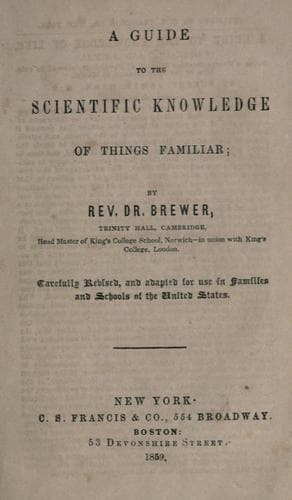
A Guide to the Scientific Knowledge of Things FamiliarBrewer, Ebenezer Cobham
Science
A Guide to the Scientific Knowledge of Things Familiar
Brewer, Ebenezer Cobham
Science -- Juvenile literature
A. Because, as they come over the _vast continents_ of Asia and Europe,
they absorb _very little water_.
Q. _Why does their imbibing so little water make them DRY winds?_
A. Being thirsty when they reach our island, they readily imbibe
moisture from the air and clouds; and, therefore, _bring dry weather_.
Q. _Why is the NORTH WIND in England generally COLD?_
A. The north wind comes from the _polar regions_, over mountains of
snow, and seas of ice; in consequence of which, it is very _cold_.
Q. _Why are NORTH WINDS in England generally DRY and biting?_
A. As they come from regions _colder than our own_, they are _warmed by
the heat of our island_; and (as their temperature is raised) _they
absorb moisture_ from every thing they touch; in consequence of which,
they are both _dry and parching_.
Q. _Why is the SOUTH WIND generally WARM in England?_
A. The south wind comes over the hot sandy deserts of Africa, and is
heated by the land it traverses.
Q. _Why does the SOUTH WIND often bring us RAIN?_
A. The south wind (being much _heated_ by the hot sands of Africa)
_imbibes water very plentifully_, as it passes over the Mediterranean
Sea and British Channel.
Q. _Why does the SATURATION of the south wind cause RAIN?_
A. As soon as it reaches our cold climate, _it is condensed_, and its
vapour is squeezed out (as water from a wet sponge).
Q. _Why are WEST WINDS in England generally RAINY?_
A. The west winds come over the _Atlantic Ocean_, and are laden with
_vapour_: if, therefore, they meet with the least _chill_, some of the
vapour is squeezed out.
Q. _Why is a fine CLEAR DAY sometimes OVERCAST in a few minutes?_
A. Because some _sudden change of temperature_ has condensed the vapour
of the air _into clouds_.
Q. _Why are CLOUDS sometimes DISSIPATED quite as suddenly?_
A. Because some _dry wind_ (blowing over the clouds) has _imbibed their
moisture_, and carried it off in invisible vapour.
Q. _Why does a SOUTH-WEST wind bring us RAIN?_
A. As it comes from the _torrid zone_, and _crosses the ocean_, the hot
wind is _laden with vapour_; and as some of the heat escapes (as soon
as it reaches our northern island) the _vapour is condensed_, and
precipitated as rain.
Q. _Why does a NORTH-EAST wind RARELY bring RAIN?_
A. As it comes from a climate _colder than our own_, its capacity for
imbibing vapour is _increased_ when it reaches our island; in
consequence of which, it _dries the air_, dispels the clouds, and
promotes evaporation.
Q. _Why does WIND sometimes bring RAIN, and sometimes FINE weather?_
A. If the wind be _colder than the clouds_, it will condense their
vapour into _rain_: if the wind be _warmer than the clouds_, it will
_dissolve_ them, and cause them to disappear.
Q. _Why are MARCH winds DRY?_
A. Because they generally blow from the east or north-east; and,
therefore, _sweep over the continent of Europe_.
Q. _What is the USE of MARCH winds?_
Public-domain text, read in full here on John Shaqi.
Reviews
Reviews
No reviews yet
Be the first to share your thoughts on this work.
Elsewhere in the archive
Join the Discussion
Join the discussion
Sign in to leave a comment or review.
Sign InorCreate an account