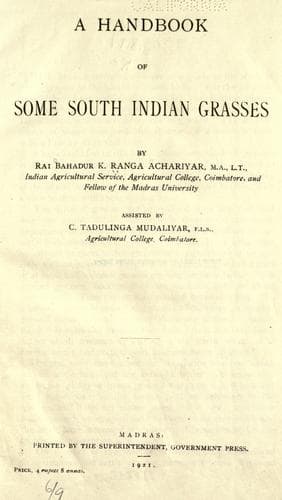
A Handbook of Some South Indian GrassesRangachari, K.
Science
A Handbook of Some South Indian Grasses
Rangachari, K.
Grasses -- India, South; Plants -- India, South
The _inflorescence_ is diffuse, pyramidal, 1 to 3 inches by 3/4 to 2
inches, on a slender glabrous peduncle 1 to 6 inches long, main rachis
is slender and angled, with a glandular streak or without it. Branches
are effuse, fine, capillary (more so than in S. coromandelianus),
obliquely ascending, never stiff and horizontal, verticillate or
irregularly subverticillate, the lowest whorl of five to twelve and the
others three to seven branches; the rachis of the branches is obscurely
scaberulous, slightly swollen at the point of insertion; branchlets are
never appressed to the branch, always drooping and spreading on all
sides, and bearing two to four spikelets.
The _spikelets_ are about 1/16 inch long, ovate-lanceolate, acute or
acuminate dark or pale green, sometimes purplish, solitary or two to
four on long slender pedicels, drooping, never appressed, and with
glandular streaks. There are three _glumes_. The _first glume_ is
minute, hyaline, ovate, obtuse or acute, nerveless. The _second glume_
is five or six times as long as the first, ovate lanceolate, 1-nerved,
acuminate. The _third glume_ is equal to or a little shorter than the
second, ovate-lanceolate, acute, 1-nerved paleate; _palea_ is equal to
the third glume, 2-nerved splitting into two halves between the nerves.
_Anthers_ are three and purple in colour. _Stigmas_ are white and
feathery. Grain as in _S. coromandelianus_.
In Flora of British India, this plant is included under Sporobolus
coromandelianus. These two plants (_S. coromandelianus_ and _S.
commutatus_) are quite distinct and grow side by side. As the
differences are not easily seen in herbarium specimens the two plants
are put together under the one species _S. coromandelianus_. The
branches are tufted and are usually decumbent at base, leaves quite
green and somewhat broad in _S. coromandelianus_; and in _S.
commutatus_, branches are usually not decumbent at base, generally erect
from the base and leaves are green glaucous and somewhat narrow. The
most striking difference, however, is in the panicle. The branches of
the panicle are always stiff and horizontal in S. coromandelianus and
the spikelets are appressed to the branches and never spreading or
drooping, whereas in _S. commutatus_ the branches are never stiff and
horizontal, always obliquely ascending and the spikelets are spreading
and drooping. Judging from living plants these two are undoubtedly
distinct and so this plant is treated as a distinct species retaining
Kunth's name _Sporobolus commutatus_. Enumeratio Plantarum, Pl. I, 214.
_Distribution._--This occurs in Coimbatore, Madras and Bellary
Districts; but it is not so common nor so widely distributed as S.
coromandelianus, _L._
[Illustration: Fig. 185.--Sporobolus scabrifolius.]
=Sporobolus scabrifolius, _Bhide._=
Public-domain text, read in full here on John Shaqi.
Reviews
Reviews
No reviews yet
Be the first to share your thoughts on this work.
Elsewhere in the archive
Join the Discussion
Join the discussion
Sign in to leave a comment or review.
Sign InorCreate an account