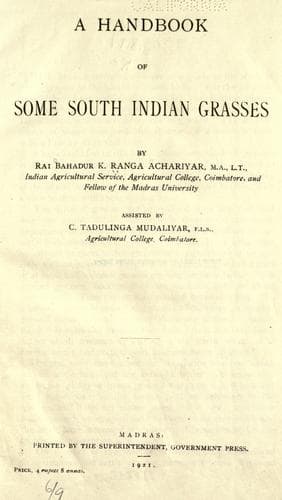
A Handbook of Some South Indian GrassesRangachari, K.
Science
A Handbook of Some South Indian Grasses
Rangachari, K.
Grasses -- India, South; Plants -- India, South
The _spikelets_ are small, shortly stalked, 4- to 8-flowered, 1/10 to
1/6 inch with the _rachilla_ produced between the flowering glumes. The
_first glume_ is small, oblong, obtuse or apiculate. The _second glume_
is similar to the first but twice as long as the first glume. The _third
glume_ and the succeeding flowering glumes are ovate-oblong, obtuse or
apiculate, with sub-marginal lateral veins; _palea_ are broadly oblong
with silkily ciliate keels. _Anthers_ are usually very small. Grain is
oblong, obtusely trigonous, or concavo-convex, red-brown and rugulose on
the ventral side.
This grass is very common amidst paddy in wet lands and in wet
situations.
_Distribution._--Throughout India and Ceylon in wet places. Also in
China, Japan and Australia.
CHAPTER X.
TRIBES VII AND VIII--FESTUCACEAE AND HORDEAE.
=Festucaceae= is of minor importance as it is not well represented in the
South India. Only about half a dozen genera occur and most of them on
the hills. The spikelets are usually 2- or more-flowered, pedicelled and
in panicles, open or contracted. The rachilla is produced beyond the
flowering glumes and articulate at the base just above the empty glumes.
Inflorescence a raceme, spikelets 2- to
3-flowered, turbinate; glumes single-awned. 40. Pommereulla.
Inflorescence paniculate, spikelets few
or many-flowered, glumes many-nerved
and many-awned. 41. Pappophorum.
Inflorescence various, spikelets 2- to
many-flowered, flowering glumes 1-
to 3-nerved entire, empty glumes
shorter than the lowest flowering
glume, grain very minute. 42. Eragrostis.
=Hordeae= is also a minor tribe and is represented by only one genus in
South India.
The spikelets are one-or more-flowered, sessile, 1- or 2-seriate on the
rachis, and somewhat sunk in cavities; the rachilla is jointed at the
base and is produced beyond the flowering glumes, glumes awned or not.
Spikelets 1- to 3-flowered, first glume very
minute or wanting, second as long as the
hyaline, third spike compressed, solitary. 43. Oropetium.
40. Pommereulla, _Linn. f._
This is a short, stout, creeping perennial grass. Spikelets are 2- to
3-flowered, distichously racemed, narrowly turbinate, villous. Glumes
are 5 to 7 in a spikelet. The first two glumes are narrow, membranous,
persistent, the first glume being 1-nerved and shorter than the second
which is 3- to 5-nerved. The third and the fourth glumes embracing the
fifth and the sixth are empty, flabelliform, 4-lobed, and dorsally
shortly awned. The fifth, sixth and the seventh are cuneate, obovate and
3-lobed, palea ovate, acute, and pubescent. Lodicules are two and
membranous. Stamens are two to three with small anthers. Grain is
oblong, compressed and free.
[Illustration: Fig. 213.--Pommereulla Cornucopiae.]
=Pommereulla Cornucopiae, _Linn. f._=
Public-domain text, read in full here on John Shaqi.
Reviews
Reviews
No reviews yet
Be the first to share your thoughts on this work.
Elsewhere in the archive
Join the Discussion
Join the discussion
Sign in to leave a comment or review.
Sign InorCreate an account