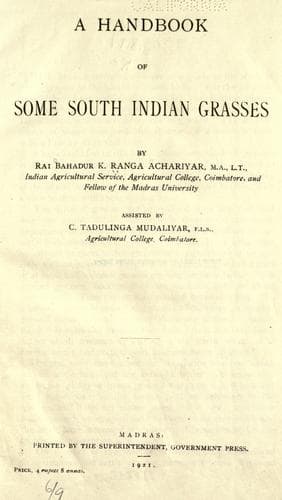
A Handbook of Some South Indian GrassesRangachari, K.
Science
A Handbook of Some South Indian Grasses
Rangachari, K.
Grasses -- India, South; Plants -- India, South
_Spikelets_ are linear to ovate-oblong, compressed, pale or green,
sometimes purple tinged at the base, few to 40-flowered and occasionally
up to 70-flowers, 1/8 to 1 inch.
The _empty glumes_ are subequal or the first is a little shorter, ovate,
acute, membranous, keeled, and sometimes the keels with glands; the
_first glume_ is usually one-nerved (rarely obscurely one- to
three-nerved) and the _second glume_ is three-nerved.
The _flowering glumes_ are broadly ovate, oblique, obtuse, sometimes
with a minute mucro, sub-chartaceous, punctulate, strongly three-nerved,
paleate, about 1/12 inch long; palea is shorter than the glume, curved,
obovate-oblong, keels ciliolate and persistent. _Stamens_ are three with
very small pale yellow anthers. Stigmas are two and white. _Lodicules_
are very small. Grain is globose reddish brown, minutely and obscurely
lineolate.
This grass is a very common weed occurring in cultivated dry fields all
over this Presidency.
_Distribution._--Throughout India and Ceylon in the plains and low
hills. Occurs also in tropical and sub-tropical parts of Asia and
Africa.
[Illustration: Fig. 223.--Eragrostis Willdenoviana.]
=Eragrostis Willdenoviana, _Nees._=
This is a tufted annual. Stems are leafy at the base, erect or
geniculately ascending, slender but rigid, varying in length from 4 to
18 inches.
The _leaf-sheath_ is smooth, cylindric, glabrous, outer margin ciliate;
tufts of long hairs are present at the sides of the margin of the
sheath, just outside close to the hyaline patch. The _ligule_ is a
fringe of short white hairs. The _nodes_ are greenish or with a tinge of
purple, glabrous and with a glandular ring below.
The _leaf-blade_ is lanceolate-linear, pointed, flat, rigid, the margin
is very minutely serrulate, glandular and occasionally also with fine
long hairs; the upper surface is somewhat rough, the lower smooth and
both with fine long scattered hairs or glabrous.
[Illustration: Fig. 224.--Eragrostis Willdenoviana.
1. Spikelets; 1_a._ 1st glume; 2 and 2_a._ the second glume; 3 and 3a.
the flowering glume; 4. palea of the flowering glume; 5. lodicules,
stamens and the ovary; 6. grain.]
The _inflorescence_ is a stiff open panicle, ovate to oblong, 2 to 4-1/2
inches long on a slender, terete, glabrous peduncle; the main _rachis_
is angular, slender with glandular scars, a little below the attachment
of the branches; the branches are capillary, grooved stiff and spreading
with small glandular scars just above the node. The _spikelets_ are
elliptic-oblong to linear, 1/8 to 3/4 inch by about 1/20 inch, greenish
or tinged with purple, few to about 25 (or sometimes even up to 42)
glumed, pedicellate; pedicel is capillary, grooved and angular, with a
glandular ring about the middle, spreading sometimes at right angles,
rachilla is persistent.
Public-domain text, read in full here on John Shaqi.
Reviews
Reviews
No reviews yet
Be the first to share your thoughts on this work.
Elsewhere in the archive
Join the Discussion
Join the discussion
Sign in to leave a comment or review.
Sign InorCreate an account