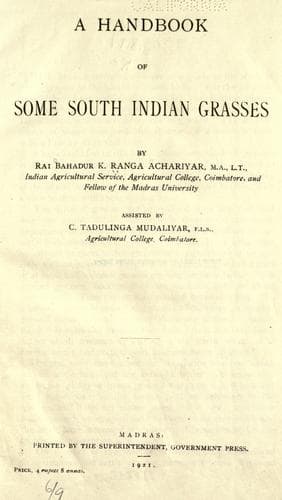
A Handbook of Some South Indian GrassesRangachari, K.
Science
A Handbook of Some South Indian Grasses
Rangachari, K.
Grasses -- India, South; Plants -- India, South
This is a fairly common grass especially in cultivated ground all over
the Presidency, but not very widely distributed. Cattle are fond of this
grass.
_Distribution._--Throughout India.
=Setaria intermedia, _R. & S._=
This is an annual with straggling, slender, erect or ascending stems, 2
to 3 feet long.
The _leaf-sheath_ is glabrous, keeled, with the margins ciliate with
long hairs. The _ligule_ is a fringe of close set long hairs. The
_nodes_ are glabrous and the lower rooting.
The _leaf-blade_ is linear-lanceolate, narrowed towards the base, finely
acuminate, with fine hairs scattered on both the surfaces and with
numerous long hairs at the mouth and with very finely serrate margins,
varying in length from 2 to 8 inches or more, 1/8 to 3/4 inch in
breadth.
The _inflorescence_ is a narrowly pyramidal spike-like panicle, 4 to 6
inches long, the main rachis is glabrous and grooved, branches are
short, crowded above, scattered and distant below, with close and
densely set spikelets; the bristles of involucels are 1/4 inch long,
slender, flexuous with erect barbs varying in number from three to six.
The _spikelets_ are ovoid.
There are four _glumes_ in the spikelet. The _first glume_ is orbicular,
oblong or ovate, about one-third the length of the third glume, hyaline,
3-nerved. The _second glume_ is half as long as the third, broadly
ovate, hyaline, 5-nerved. The _third glume_ is as long as the fourth,
broadly ovate, thinly membranous, 5-nerved, paleate, empty. The _fourth
glume_ is broadly ovate, or suborbicular, very concave, coriaceous,
transversely rugulose, yellowish brown. _Anthers_ are orange or yellow
and _styles_ purplish. _Lodicules_ are very small.
[Illustration: Fig. 110.--Setaria intermedia.
1. A branch with spikelets; 2 and 2a. spikelets; 3, 4 and 5. the first,
second and the third glume, respectively; 5a. the palea of the third
glume; 6. the fourth glume; 6a. the fourth glume and its palea; 6b.
palea of the fourth glume; 7. ovary, anthers and lodicules.]
Fairly common in rich soils in sheltered places. Cattle are very fond of
this grass as the leaves are flaccid and tender.
_Distribution._--Probably all over India.
[Illustration: Fig. 111.--Setaria verticillata.]
=Setaria verticillata, _Beauv._=
This is an annual grass, with erect, ascending, stout or slender, leafy
stems, more or less branched and varying in length from 1 to 5 feet.
The _leaf-sheaths_ are smooth, glabrous. The _ligule_ is a fringe of
hairs. _Nodes_ are glabrous.
The _leaf-blades_ are thin, flat, glabrous, sparsely hairy and
scaberulous, linear or linear-lanceolate, tapering to a fine point, base
usually narrowed, 4 to 10 inches long and 1/4 to 3/4 inch broad.
The _inflorescence_ is a spike-like or subpyramidal panicle, cylindric
or oblong, coarsely bristly, 2 to 7 inches long, bristles one or few,
studded with conspicuously reversed barbs or teeth, 1/6 to 1/3 inch
long.
The _spikelets_ are ellipsoidal, obtuse, glabrous, 1/12 inch long.
Public-domain text, read in full here on John Shaqi.
Reviews
Reviews
No reviews yet
Be the first to share your thoughts on this work.
Elsewhere in the archive
Join the Discussion
Join the discussion
Sign in to leave a comment or review.
Sign InorCreate an account