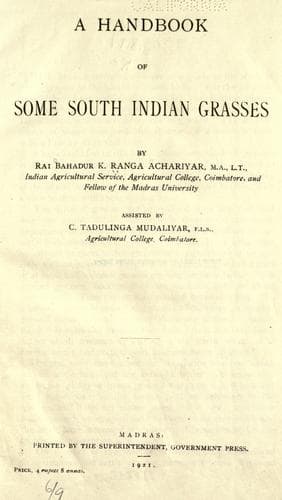
A Handbook of Some South Indian GrassesRangachari, K.
Science
A Handbook of Some South Indian Grasses
Rangachari, K.
Grasses -- India, South; Plants -- India, South
These are annual or perennial grasses, with erect or prostrate stems.
Inflorescence is a spiciform raceme, bearing the spikelets in clusters
of 2 to 4. The spikelets are 1-flowered and usually with two glumes.
Sometimes a very minute hyaline lower glume is present. The first glume
is thickly coriaceous, 5-ribbed, oblong-lanceolate, and ribs with long
recurved spines. The second glume is oblong or oblong-lanceolate,
apiculate, chartaceous, 3-nerved and with a perfect flower; palea is as
long as the glume, 2-nerved. Lodicules are broad, cuneate and fleshy.
There are three stamens. Styles are slender and distinct, with narrow
stigmas exserted from the top of the glume. Grain is oblong to
ellipsoidal free within the glume and its palea.
[Illustration: Fig. 122.--Tragus racemosus.]
=Tragus Racemosus, _Scop._=
This plant is a perennial with tufted prostrate or erect stems, rooting
at the nodes freely and densely leafy. The flowering branches are erect
or geniculately ascending and varies from a few inches to about a foot.
The _leaf-sheath_ is short, pale, glabrous, somewhat compressed,
striate, equitant below and upper are longer, terete and green. The
_ligule_ is only a ridge of short, fine hairs. _Nodes_ are glabrous.
The _leaf-blade_ is convolute when young, ovate or ovate-lanceolate,
variable from 1/4 to 2 inches long and 1/10 to 1/6 inch wide, acuminate,
flat or somewhat wavy, glabrous on both the surfaces, rigidly pungent,
densely crowded and distichously imbricate in the lower part of the
stem, base is amplexicaul, and the margin is distantly serrate and
rigidly ciliate.
The _inflorescence_ is a spike-like terminal panicle varying in length
from 3/4 to 2 inches; the _rachis_ is wavy, slender, angular or grooved,
pubescent, the peduncle is striate, pubescent and enclosed by the
leaf-sheath.
The _spikelets_ are arranged in groups of two, facing each other and
appearing like a single spikelet with two equal echinate glumes,
sessile, or obscurely pedicelled on very short, tumid, pubescent
branches.
[Illustration: Fig. 123.--Tragus racemosus.
1. A pair of spikelets; 2, 3 and 4. the first, second and the third
glume, respectively; 5. palea of the third glume; 6. ovary, anthers and
lodicules.]
Public-domain text, read in full here on John Shaqi.
Reviews
Reviews
No reviews yet
Be the first to share your thoughts on this work.
Elsewhere in the archive
Join the Discussion
Join the discussion
Sign in to leave a comment or review.
Sign InorCreate an account